


1.0 Introduction: The Quest for the Perfect Cell Population
For life science researchers, the success of a downstream experiment often hinges on the quality of the starting material. The constant need to isolate pure, viable, and functional cell populations is a foundational challenge. Whether for cell therapy development, functional studies, or molecular analysis, obtaining the right cells is the critical first step.
Magnetic cell separation has become a cornerstone technique for its efficiency and specificity. However, achieving the best possible outcome involves more than just selecting a kit that targets your cell marker of choice.
The optimal strategy requires a deeper understanding of the underlying technology and the trade-offs inherent in different approaches. A decision that seems minor—like the type of bead or labeling method—can have a significant impact on your results, budget, and timeline.
This article moves beyond basic protocols to explore the critical—and often surprising—trade-offs that can make or break an experiment. By understanding these strategic decision points, you can move from simply following a kit's instructions to designing a cell isolation workflow that is perfectly optimized for your scientific goals.
2.0 Takeaway 1: Speed vs. Flexibility—The Direct vs. Indirect Labeling Dilemma
The first strategic choice in magnetic cell separation is your labeling method. This decision sets the stage for your entire workflow and hinges on a primary trade-off between speed and experimental flexibility.
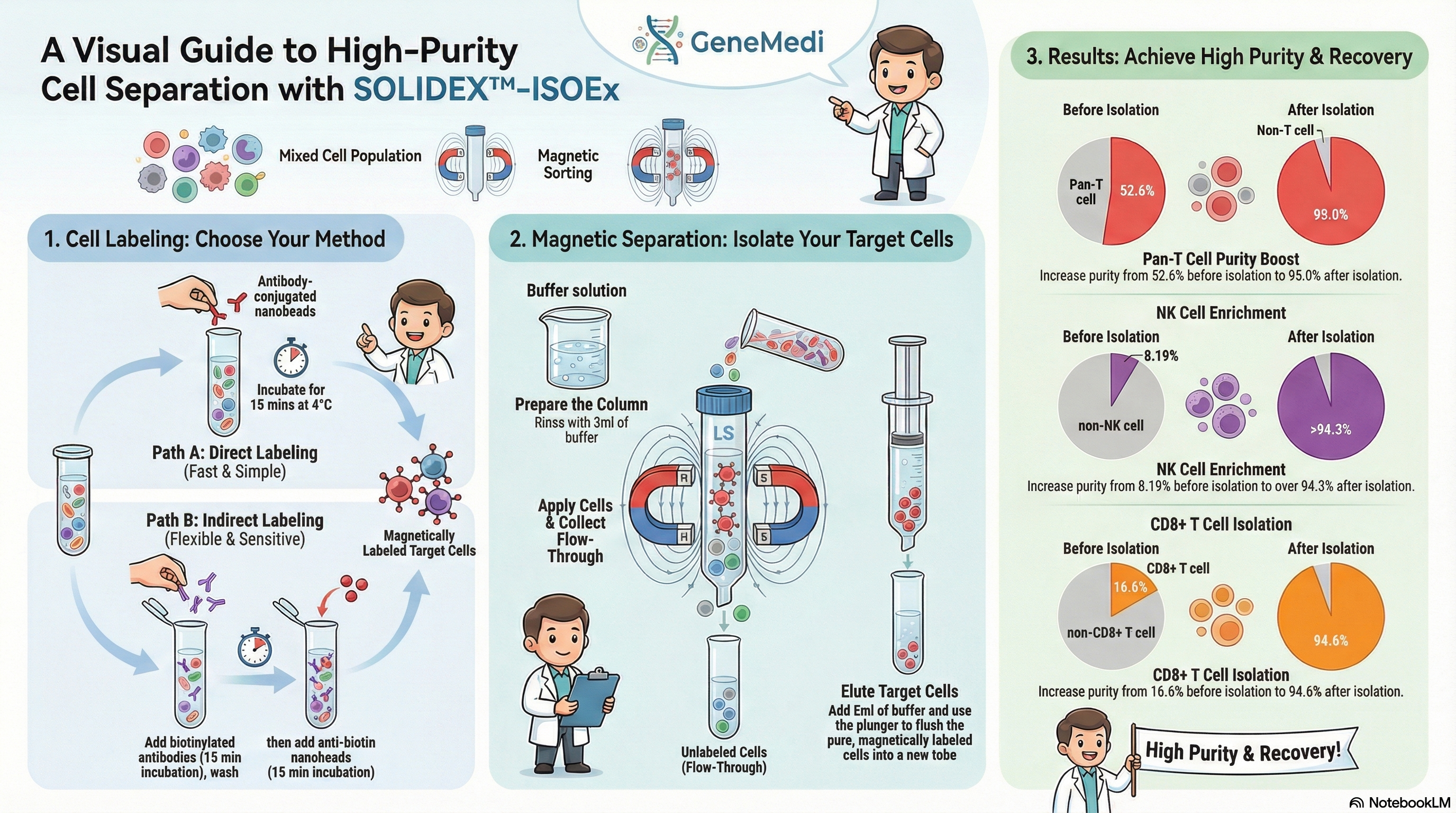
- Direct Isolation: In this method, the antibodies that recognize your target cell are directly conjugated to the magnetic beads. It's a single-step labeling process designed for immediate cell targeting.
- Indirect Isolation: This two-step method uses a biotinylated primary antibody to first tag the target cells. Then, magnetic beads coated with streptavidin (SA) or an anti-biotin antibody are added to capture the labeled cells.
The choice isn't about which method is universally "better," but which is best suited for your specific application. The table below summarizes the key trade-offs.
| Direct Isolation Advantages | Direct Isolation Limitations | Indirect Isolation Advantages | Indirect Isolation Limitations |
|---|---|---|---|
| Fastest method | Limited flexibility | Antibody flexibility | Longer protocol |
| Simplified workflow | Higher cost per target | Cost-effective | Potential for higher background |
| High specificity | Signal amplification |
This is a critical takeaway because it frames your approach from the start. Direct isolation is the champion of speed and standardization, offering a simplified workflow that is ideal for routine, well-established protocols where time is of the essence.
However, this comes at the cost of flexibility and requires dedicated bead-antibody conjugates for each new target. Conversely, while indirect isolation's two-step process takes longer and may introduce potential for higher background, its unparalleled flexibility and cost-effectiveness allow you to mix and match different biotinylated primary antibodies with the same set of magnetic beads, making it perfect for complex, multi-marker sorting experiments or for targeting low-abundance cells where signal amplification is beneficial.
3.0 Takeaway 2: To Keep or To Toss—Rethinking Releasable vs. Non-Releasable Beads
If you choose an indirect labeling strategy, you face another key decision: whether to use releasable or non-releasable beads. This choice directly impacts your workflow, cost, and the state of your final cell product.
- Releasable Beads: Typically using an anti-biotin linkage, these beads allow for detachment from the cell surface, usually through competitive biotin elution. The end result is a population of bead-free cells.
- Non-releasable Beads: These beads use the powerful and irreversible bond between streptavidin (SA) and biotin. Once attached to the cell, the beads are there to stay.
The most valuable insight here is often counter-intuitive. While releasable beads might seem superior, non-releasable beads are simpler, more economical, and perfectly suited for negative selection (depletion).
In these protocols, the goal is to remove unwanted cells from a population. The bead-bound cells are the ones you discard, so there is no need for the extra step and cost of bead removal.
Releasable beads become critical when the positively selected cells are your desired product and must be bead-free for downstream applications. Sensitive assays like sequencing, long-term cell culture, or cell transplantation often require "untouched" cells, making the gentle detachment offered by releasable systems essential.
Understanding this distinction allows you to save money and simplify your workflow by not defaulting to a more complex releasable system when it's simply not necessary.
4.0 Takeaway 3: Purity vs. Practicality—Are You Over-Engineering Your Isolation with Columns?
The final physical format of your separation system—column-based or column-free—presents another trade-off, this time between achieving the absolute highest purity and optimizing for speed and practicality.
- Column-Based Systems: These systems use magnetic separation columns packed with a matrix. Cells labeled with typically 50 nm magnetic beads are passed through the column, which is placed in a strong magnetic field. The magnetic field is amplified within the column, ensuring highly efficient capture of labeled cells and leading to exceptional purity.
- Column-Free Systems: This method is a faster, simpler alternative. Labeled cells are mixed in a tube, which is then placed in a magnetic separator. The magnetic cells are held to the side of the tube while the unlabeled fraction is removed. The entire process can often be completed in under 15 minutes.
The key trade-off is clear: the exceptional, automation-friendly purity of column-based systems versus the incredible speed, user-friendliness, and cost-effectiveness of column-free systems.
For many routine research applications, exploratory studies, or quick experiments, the rapid processing of a column-free system is a more practical and efficient choice. Over-engineering your isolation with a column-based system may not be necessary.
Reserve the column-based approach for when purity is the absolute, non-negotiable priority, such as isolating very rare cell populations like circulating tumor cells (CTCs) or preparing samples for high-throughput automated workflows.
5.0 Takeaway 4: Performance You Can See—Not All Nanobeads Are Created Equal
Beyond the strategic choices of labeling and format, the physical quality of the magnetic beads themselves is a fundamental determinant of performance. GeneMedi's SOLIDEX™-ISOEx Nanobeads, for example, are built using 50 nm superparamagnetic iron oxide particles.
According to performance documentation, a key physical characteristic is that "The SOLIDEX™-ISOEx Nanobeads from GeneMedi exhibit uniform size and regular shape."
This isn't just an aesthetic quality; it has a direct impact on experimental outcomes. Uniformity in size and shape contributes to a rapid and consistent magnetic response, which in turn leads to high reproducibility between experiments and minimal negative impact on cell viability and activity.
Performance data illustrates this point effectively:
- In a head-to-head comparison isolating TCRα/β+ T cells from human PBMCs, the SOLIDEX™-ISOEx kit achieved 97% purity, while a competitor's kit (Company M) reached 96.1%. While a 0.9% difference may seem small, in sensitive downstream applications like single-cell analysis, this increased purity can significantly reduce noise and improve data quality.
- In another example using the SOLIDEX™-ISOEx Untouched Human NK Cell Isolation Kit (Column-Based), the purity of the target NK cells was enriched from 8.19% in the pre-isolation sample to an impressive 94.3% post-isolation.
This high-performance standard is consistent across a range of cell types, with similar high-purity results demonstrated in the isolation of Pan-T, CD4+, CD8+, and B cells, validating the reliability of the SOLIDEX™-ISOEx platform.
6.0 Conclusion: From Protocol to Strategy
Successful cell separation is not just about following a protocol; it's about making a series of strategic decisions tailored to your specific scientific goals, timeline, and budget.
By thinking critically about the trade-offs at each step, researchers can elevate their approach from a simple task to a sophisticated strategy.
Mastering the trade-offs between speed and flexibility in labeling, knowing when to leverage economical non-releasable beads, and strategically choosing between column-based and column-free systems empowers you to design a superior experimental workflow.
These choices, combined with the use of high-quality, uniform nanobeads, create a powerful framework for achieving pure, viable, and functional cells for any downstream application.
Now that you know the hidden trade-offs, which part of your cell isolation workflow could be optimized for better results?