The onset of autoimmune diseases arises from the immune system mistakenly attacking the body's own tissues. Regulatory T cells (Tregs) are the core cell population that maintains immune tolerance. The CD137 molecule is expressed on the surface of some Tregs, but its specific function has long remained unclear. A recent study published in the Journal of Experimental Medicine used the NOD mouse model to reveal the critical immunoregulatory role of CD137 in Tregs.
Research Background
CD137 (4-1BB) belongs to the tumor necrosis factor receptor superfamily and is a costimulatory molecule for T cell activation. Through alternative splicing, CD137 exists in two forms: membrane-bound and soluble. Previous studies have found that CD137 promotes the survival and proliferation of effector T cells, but its role in Tregs remains unclear.
NOD mice are a classic animal model for studying type 1 diabetes. Prior studies have shown that serum soluble CD137 levels are associated with diabetes susceptibility, but whether Tregs are the main source of soluble CD137 in vivo, and whether they possess immunosuppressive function, has long lacked direct evidence.
Research Objectives
This study aimed to answer three core questions: Does Treg-derived CD137 suppress autoimmune responses? Do membrane-bound and soluble CD137 have different functions? How does CD137 deficiency affect the state of T cells within the pancreatic islets?
The researchers constructed NOD mouse models with Treg-specific knockout of CD137, deleting either all CD137 molecules or only membrane-bound CD137, to distinguish the functional differences between the two forms.
Research Methods (Brief)
The researchers used CRISPR/Cas9 technology to construct two types of conditional knockout mice: one deleting all exons of CD137, and another deleting only exon 7, which encodes the transmembrane domain, while preserving the production of soluble CD137.
Through flow cytometry analysis of immune cell subsets, combined with single-cell RNA sequencing and T cell receptor sequencing, the transcriptional states and clonal expansion of T cells within the pancreatic islets of wild-type and knockout mice were systematically compared.
Core Findings
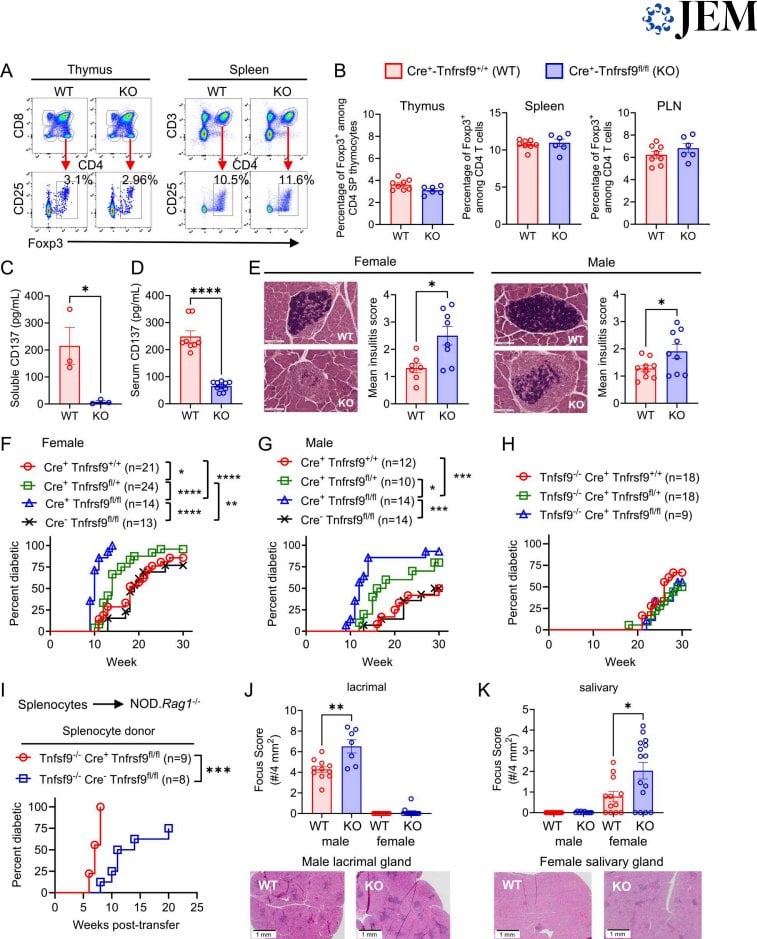
Tregs are the main source of soluble CD137 in vivo. After Treg-specific knockout of CD137, serum soluble CD137 levels decreased by 70%, confirming that Tregs are the primary producers of circulating soluble CD137.
CD137 deficiency accelerates diabetes onset. Mice with Treg-specific knockout of CD137, regardless of sex, showed significantly earlier diabetes onset. Heterozygous mice exhibited an intermediate phenotype, suggesting a gene dosage effect.
Soluble and membrane-bound CD137 have different functions. Mice with deletion of only membrane-bound CD137 showed delayed diabetes onset compared to the complete knockout group, but still faster than wild-type. This indicates that both forms of CD137 participate in immunosuppression, and their functions cannot fully substitute for each other.
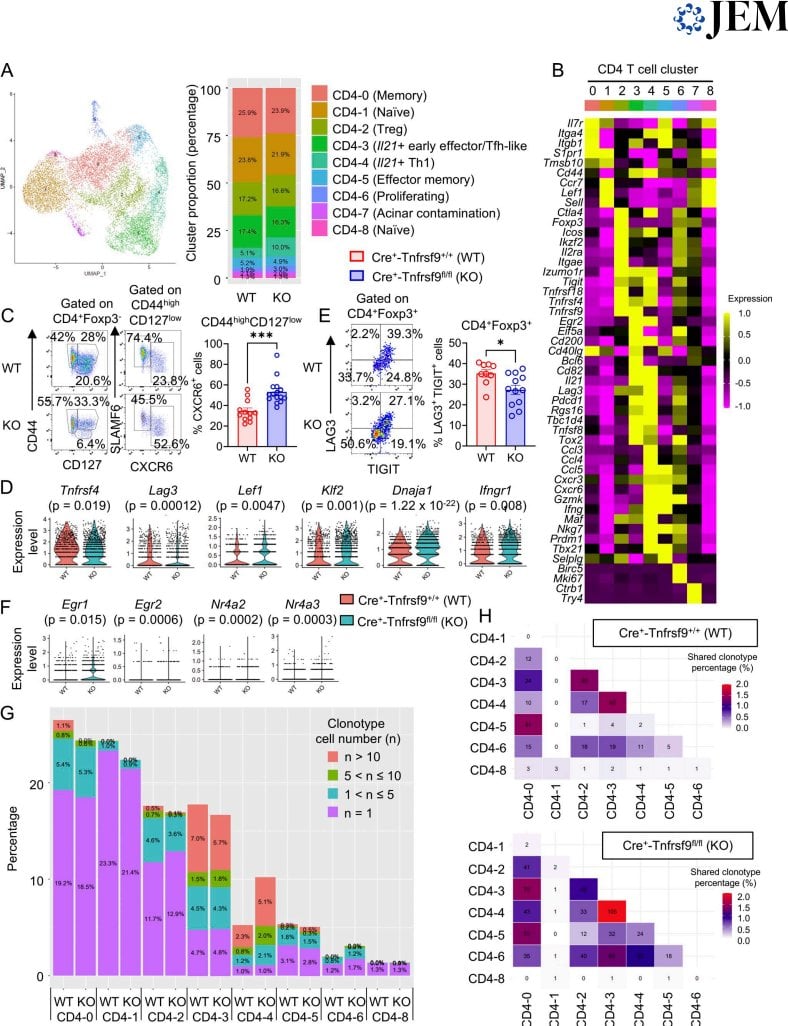
CD137 regulates the differentiation state of Tregs. Single-cell sequencing showed that CD137-deficient Tregs tend to remain in a naive state, with reduced differentiation toward highly suppressive functional subsets. TCR analysis further found that CD137 signaling is crucial for the clonal expansion of Tregs.
CD137 deficiency enhances effector T cell activation. In the pancreatic islets of knockout mice, the proportions of CD8 and CD4 effector T cells increased, the expression of the proliferation marker Ki67 increased, and terminally differentiated effector cells (such as CXCR6+TIM3+CD8 T cells) significantly increased.
Innovations or Breakthroughs
The innovation of this study lies in the construction of two refined gene knockout models, providing the first direct in vivo evidence that Treg-derived soluble CD137 has immunosuppressive function. Previous antibody stimulation experiments could not distinguish the effects of the two CD137 forms, whereas genetic approaches provided evidence closer to physiological conditions.
Single-cell multi-omics analysis revealed the molecular mechanism by which CD137 regulates Treg differentiation. CD137 deficiency leads to altered Treg differentiation trajectories and a decreased proportion of highly suppressive functional subsets, providing a new perspective for understanding the regulation of Treg function.
Practical Significance
This study has potential guiding value for the treatment of autoimmune diseases. Human Tregs also express CD137 and produce soluble CD137, and serum soluble CD137 levels in type 1 diabetes patients are lower than in healthy controls. This suggests that the CD137 pathway may be a potential target for therapeutic intervention.
The study also revealed the opposing roles of CD137 in CD8 T cells and Tregs: in CD8 T cells, it promotes their pathogenic activity, while in Tregs, it maintains their suppressive function. This balance relationship has reference significance for the application of anti-CD137 antibodies in tumor immunotherapy.
Summary and Reflections
This study systematically elucidated the immunoregulatory function of CD137 in Tregs, demonstrating that soluble and membrane-bound CD137 synergistically suppress autoimmunity through different mechanisms. The study also suggests that CD137 signaling indirectly controls the clonal expansion and terminal differentiation of effector T cells by maintaining the highly suppressive functional subsets of Tregs.
A question worth considering is: Does the opposing role of CD137 in Tregs and effector T cells mean that therapeutic strategies targeting the CD137 pathway require fine regulation? How can anti-tumor immunity be enhanced while avoiding disruption of Treg-mediated immune tolerance? This may be a key question that future translational research needs to answer.