Early diagnosis of cutaneous T-cell lymphoma (CTCL) has long been a challenge for dermatologists. This is especially true for the most common type, mycosis fungoides (MF), whose early skin lesions closely resemble those of eczema (atopic dermatitis) and psoriasis. Misdiagnosis is common in clinical practice, and patients often go through many years before receiving a correct diagnosis. Some data show that the median time from the appearance of skin lesions to confirmed diagnosis is as long as 3 years. Repeated biopsies are not only painful, but pathological results are also often nonspecific. Finding a non-invasive, precise molecular tool for differentiation has become an urgent clinical need.
Research Background: An Indistinguishable "Mimic"
MF is the most common type of CTCL. Most patients are at an early stage (stage IA-IIA) at initial diagnosis, presenting only with patches or plaques. It is precisely at this stage that the appearance of skin lesions and histopathology highly overlap with those of eczema and psoriasis. From the perspective of immune mechanisms, early-stage MF is dominated by Th1-type immunity, while advanced-stage disease shifts toward Th2-type—which highly coincides with the characteristic immune deviation of eczema. Psoriasis, in contrast, is mainly driven by the Th17 pathway. Molecular differences theoretically exist, but reliable markers usable for routine clinical testing are lacking. There is still no validated diagnostic classifier to distinguish these diseases.
Research Objective: Achieving Molecular Differentiation with Tape Stripping
This study attempts to answer a direct question: can tape stripping, a non-invasive sampling method, capture transcriptomic information from the skin epidermis to distinguish early-stage MF from eczema and psoriasis? Tape stripping involves merely adhering to the skin surface for a few seconds—painless, scar-free, and without risk of infection. This technique has been validated as feasible in inflammatory skin diseases such as eczema and psoriasis, but in the field of CTCL, systematic comparative studies with benign inflammatory skin diseases are still lacking.
Research Methods: Transcriptomic Comparison of 116 Samples
A total of 116 participants were enrolled in the study: 36 with eczema, 32 with psoriasis, 18 with MF, and 30 healthy controls. Among all MF patients, 88.9% were at an early stage (stage IA-IIA). The researchers performed tape stripping on both lesional and adjacent non-lesional areas of each participant, extracted RNA, and performed bulk RNA sequencing. Subsequently, through principal component analysis, differentially expressed gene identification, and pathway enrichment analysis, the molecular profiles of each disease were compared. On this basis, the researchers further constructed logistic regression classifiers, screening for key gene combinations that could distinguish MF from eczema and psoriasis.
Core Finding 1: MF Exhibits a Unique "Mixed" Immune Signature
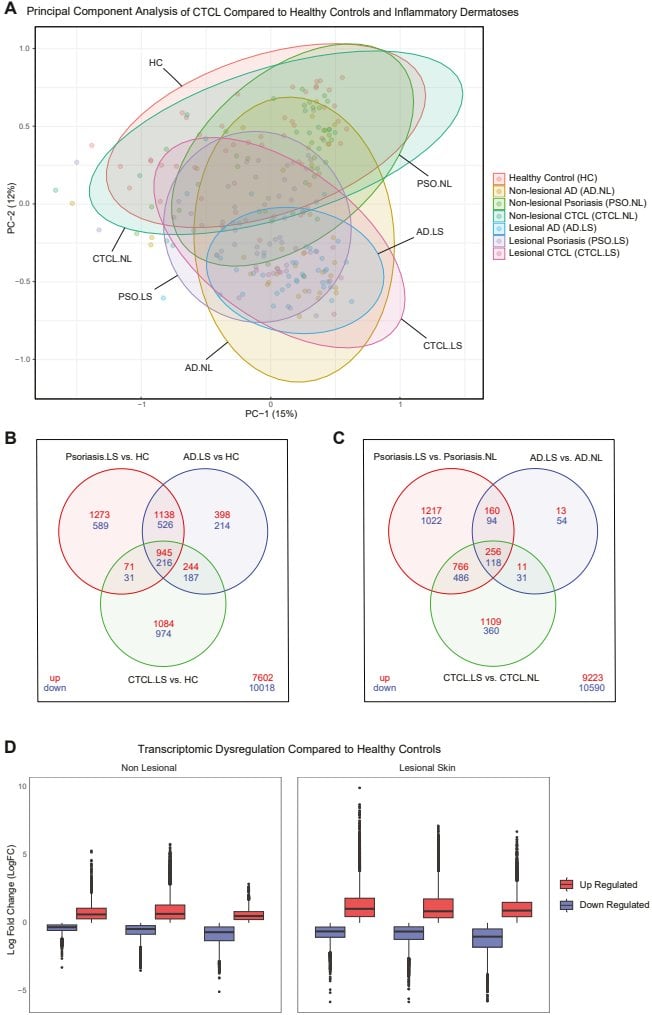
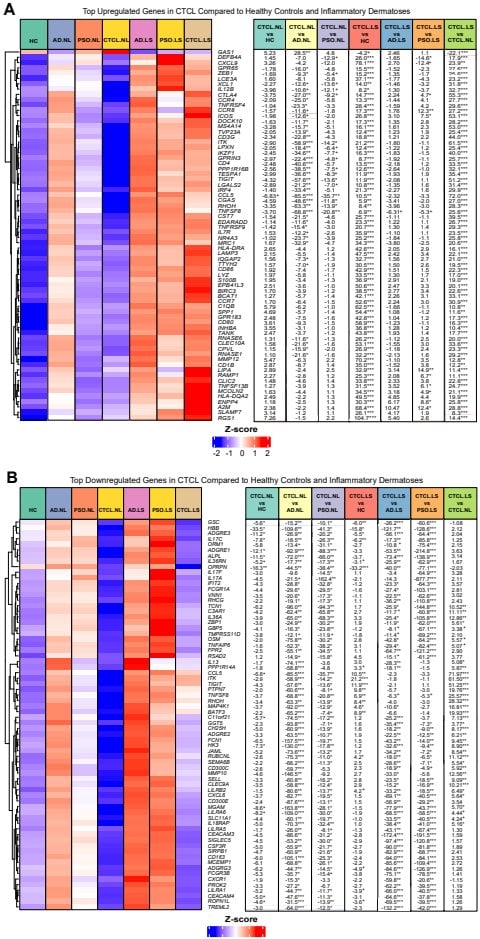
Principal component analysis showed that the lesional transcriptomes of MF, eczema, and psoriasis each formed independent clusters, clearly separated from healthy controls. Eczema exhibited typical Th2/Th22 polarization, while psoriasis was dominated by Th17/Th22. In contrast, MF did not display a single immune polarization axis, but rather a complex mixed immune profile. Genes significantly upregulated in MF lesions involved multiple functional modules: immune checkpoint regulation (CTLA4, ICOS), lymphocyte homing (CCR7, CCR8), antigen presentation (HLA-DRA, LAMP3), T-cell survival (TNFSF13B, BIRC3), and metabolic regulation, among others. Notably, the high IL13 expression characteristic of eczema was completely absent in MF, providing an important clue for differentiation.
Core Finding 2: A 5-Gene Classifier Achieves High-Precision Differentiation
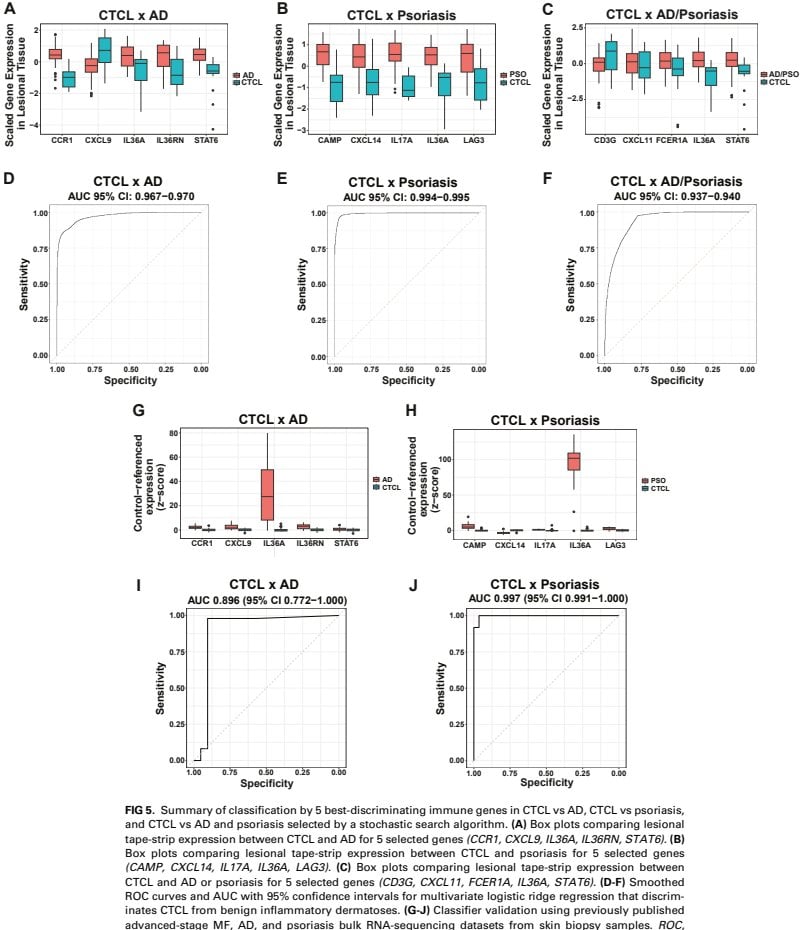
From immune-related genes, the researchers used a random search algorithm to select the optimal 5-gene combination. The best combination for distinguishing MF from eczema was CCR1, CXCL9, IL36A, IL36RN, and STAT6; for distinguishing MF from psoriasis, CAMP, CXCL14, IL17A, IL36A, and LAG3 were used. When simultaneously distinguishing MF from both benign skin diseases, the optimal combination was CD3G, CXCL11, FCER1A, IL36A, and STAT6. The AUCs of all three classifiers were near perfect. More critically, these classifiers were validated in independent skin biopsy transcriptomic datasets—the AUC for distinguishing psoriasis reached 0.997, and for distinguishing eczema, 0.896. This means that the epidermal molecular signals captured by tape stripping are sufficient to reflect disease features previously observed only in biopsy tissue.
Innovations and Breakthroughs
The core innovation of this study lies in the innovation of the sampling method. This is the first systematic study using tape-stripping transcriptomics to distinguish CTCL from benign inflammatory skin diseases. Previous comparative studies mostly relied on skin biopsy tissue, whereas tape stripping collects only the stratum corneum and superficial epidermis, with minimal trauma. Surprisingly, this superficial sampling was able to reproduce most of the key immune markers found in biopsy tissue, including CTLA4, ICOS, CCR7, and others. At the same time, the study also identified multiple new genes not previously reported in CTCL, such as BCAT1, SLAMF7, and TNFSF13B, which have records of overexpression in other hematologic malignancies, suggesting potential diagnostic or therapeutic value.
Practical Significance and Limitations
For clinical practice, this 5-gene classifier is expected to become an auxiliary tool for histopathology. Especially in the early-stage MF phase, when clinical and pathological features are difficult to distinguish from benign skin diseases, tape-stripping testing can provide additional molecular evidence to help shorten diagnostic delay. However, the study also has limitations: the CTCL cohort was mainly composed of classic MF, without including subtypes such as folliculotropic MF; the benign control group was mainly moderate-to-severe, and the ability to distinguish mild cases remains unclear; the sample size was relatively small, and most patients had received treatment. These all require validation by larger-scale prospective studies.
Summary and Reflections
This study demonstrates the potential of non-invasive molecular testing in the differential diagnosis of cutaneous lymphoma. Tape-stripping transcriptomics can not only capture the characteristic immune dysregulation of MF, but also distinguish malignant from benign inflammation with minimal trauma. For the MF diagnostic workflow that has long relied on repeated biopsies, this undoubtedly provides a gentler complementary pathway. From the perspective of translational research, this type of superficial sampling method also opens a new window for disease monitoring and assessment of treatment response.
A question worth pondering is: as non-invasive molecular testing becomes increasingly precise in identifying cutaneous T-cell lymphoma, will our definition of "early diagnosis" change accordingly? Can molecular markers ultimately replace part of histopathological assessment and become a new standard for disease stratification and efficacy evaluation? This may be one of the most noteworthy directions in the diagnosis and treatment of cutaneous lymphoma in the coming decade.