Chronic spontaneous urticaria (CSU) is a disease driven primarily by mast cells, manifesting as recurrent wheals, angioedema, or both. Approximately up to 1% of the global population is affected, and patients often experience sleep disturbances, depression, and anxiety, with significantly reduced quality of life.
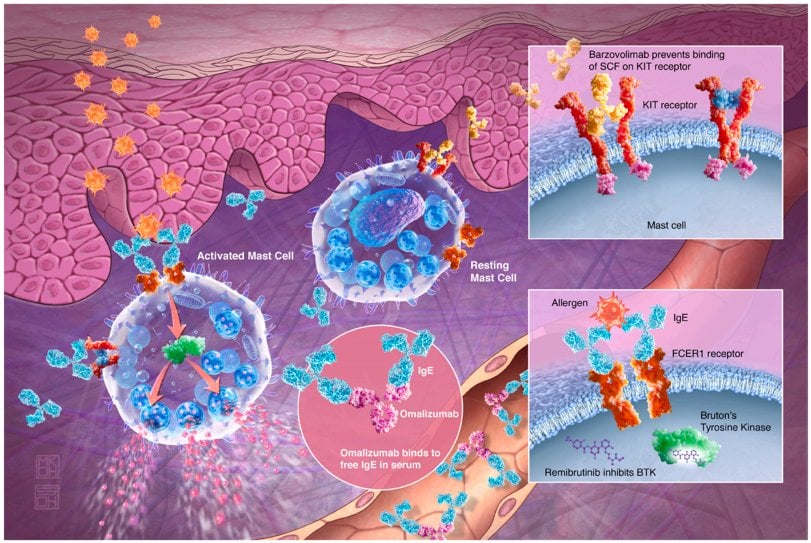
For a long time, the therapeutic approach to CSU has centered on "intercepting signals." From antihistamines to biologics targeting the IgE pathway, and further to kinase inhibitors that suppress downstream signaling pathways, all have attempted to intervene in the chain of mast cell activation. However, a considerable proportion of patients still respond poorly to these therapies or are unable to achieve complete symptom control.
This unmet clinical need has driven researchers to look toward a more fundamental link—the mast cells themselves. If mast cells in tissues could be directly eliminated, could treatment break out of the "containment war" of signaling pathways?
From "Blocking Signals" to "Dismantling Cells"
The pathogenesis of CSU has not been fully elucidated. Traditionally, researchers have described two major mast cell activation pathways: type I (autoallergic), mediated by IgE directed against self-antigens; and type IIb, driven by IgG autoantibodies directed against the IgE receptor or IgE. Recent data suggest that these two mechanisms overlap to a considerable degree.
More critically, in approximately 16% of patients, no autoantibody markers of either type can be detected. This means that regardless of how diverse the upstream mechanisms may be, they ultimately converge on the same endpoint—direct activation of mast cells and release of mediators.
This suggests a new interventional approach: rather than setting up defenses one by one along different signaling pathways, it may be better to directly reduce the number of effector cells.
Targeting the KIT Receptor
The survival and maturation of mast cells are highly dependent on KIT receptor signaling. KIT is a receptor tyrosine kinase whose ligand is stem cell factor (SCF). When SCF binds to KIT, it initiates a series of signaling cascades that maintain mast cell survival and function.
The protagonist of this study is a humanized IgG antibody targeting the extracellular domain of the KIT receptor. After binding to KIT, the antibody sterically hinders SCF from approaching the receptor, thereby cutting off this critical survival signal. Since KIT signaling is indispensable for mast cell maturation and survival, blocking this pathway can deplete mast cells in tissues.
This mechanism is fundamentally different from previous therapies: it does not inhibit mast cell activation but directly reduces the number of mast cells.
Clinical Data: Rapid Onset, Multi-Endpoint Benefits
This phase II dose-finding study enrolled 208 adults with moderate-to-severe CSU, all of whom remained symptomatic despite treatment with H1 antihistamines at up to 4 times the approved dose. Subjects were randomly assigned 1:1:1:1 to three dose groups or a placebo group.
The results showed that the antibody achieved statistically significant improvement across all primary endpoints. Symptom improvement was rapid, with noticeable changes observed as early as 2 weeks after treatment. By week 12, depending on the dose, 41.7% to 62.5% of patients achieved good disease control.
Researchers also indirectly confirmed the depletion of mast cells in tissues through a significant decrease in serum tryptase levels. A previous phase Ib study more directly demonstrated a reduction in skin mast cells—detectable by immunohistochemical staining as early as 1 week after dosing.
Behind the Efficacy: Safety Observations Must Not Be Absent
Although the strategy of targeting the KIT receptor is precise, KIT is widely expressed in the human body, which raises safety concerns about "the target itself." Data showed that 9% of treated patients developed hair hypopigmentation, consistent with the high expression of KIT in melanocytes.
In addition, KIT is essential for spermatogenesis and taste function, and inhibition of this pathway can lead to reversible spermatogenic defects and dysgeusia. In terms of the hematopoietic system, 7.7% of patients developed neutropenia, but notably, the incidence of infections did not increase in these patients or in the overall study population.
Considering that CSU is a chronic disease and patients may require long-term medication, these safety signals need to be continuously monitored in phase III trials.
Broader Possibilities
The value of this study is not limited to CSU. Therapies capable of depleting tissue-resident mast cells may have therapeutic potential for a variety of mast cell-driven diseases, including asthma, food allergy, and allergic rhinoconjunctivitis.
Within the spectrum of mast cell disorders, the treatment landscape for clonal disorders (such as systemic mastocytosis) has changed significantly in recent years, with multiple drugs targeting the KIT D816V driver mutation having been introduced. In contrast, non-clonal mast cell activation disorders lack clear driver mutations, have limited mechanistic understanding, and have even fewer treatment options.
Theoretically, directly reducing the number of tissue-resident mast cells may bring breakthroughs for this patient population that lacks targeted therapies. Where the actual boundaries of benefit for mast cell depletion strategies lie still require more research to define.
Summary and Reflections
The significance of this study lies in validating a new paradigm: depleting mast cells in tissues by targeting the KIT receptor, rather than merely intercepting their activation signals. From "blocking signals" to "dismantling cells," this shift in thinking may influence the treatment landscape of mast cell-related diseases. Of course, long-term safety data remain to be accumulated, and the depletion effects on other tissues and organs also need further confirmation.
A question worth pondering is: when the effector cell itself becomes the therapeutic target, how do we find the optimal balance between "eliminating pathogenic cells" and "preserving normal immune function"? This question may accompany the entire development journey of this class of novel therapies.