


Immunotherapy for allergy and asthma has long been trapped by a difficult problem: how to safely eliminate overactive Th2 cells. A study recently published in Immunity (including a subsequent correction) has provided an unexpected answer—T cell receptor (TCR) restimulation-induced Th2 cell death turns out to be highly dependent on Granzyme B. This finding overturns the traditional understanding of Granzyme B as merely a killing weapon released by cytotoxic T cells (CTLs).
Research Background: The Mystery of the "Suicide Switch" in Th2 Cells
The immune system maintains homeostasis through both activation and death. For Th1 cells, repeated TCR stimulation triggers a program called "activation-induced cell death" (AICD), primarily clearing overactivated cells via the Fas-FasL pathway.
However, Th2 cells are naturally resistant to Fas-mediated death. How they are eliminated in the late stages of inflammation has always lacked a clear explanation. This is not merely a basic immunology question, but is directly related to the outcome of Th2-type diseases such as allergy and asthma—if the clearance mechanism fails, inflammation persists without resolution.
Research Objective: Finding the Key Molecule in Th2 Cell Death
The researchers focused on TCR restimulation-induced Th2 cell death (TCR-induced cell death). They posed a specific question: in this process, does Granzyme B play a previously overlooked role?
Granzyme B is typically released by CTLs and NK cells, entering target cells with the aid of perforin to initiate apoptosis. However, Th2 cells themselves also express Granzyme B, and its function has long been unclear. The core objective of this study was precisely to verify whether Granzyme B is the intrinsic executor of TCR-mediated death in Th2 cells.
Research Methods: Gene Knockout and Cytological Validation
The team employed a rigorous in vitro cytological system. They isolated and polarized Th1 and Th2 cells, used anti-CD3 antibodies to simulate TCR restimulation, and observed differences in death. The key tool was Granzyme B gene knockout (Gzmb-/-) mice, used to directly test the necessity of this molecule.
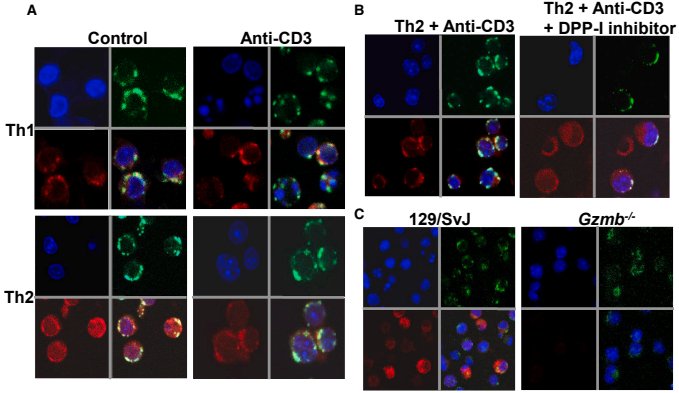
The experiments also introduced a DPP-I inhibitor—which can block the conversion of Granzyme B precursor to its active form, thereby validating the enzyme's activity requirement at the functional level. By comparing wild-type and knockout cells, the researchers were able to distinguish between Granzyme B-dependent and -independent death pathways.
Core Findings: Granzyme B Is the Key Executor of Th2 Cell Death
The results showed that after TCR restimulation, Th2 cells died in large numbers, and this process was significantly impeded in the Gzmb-/- background. Consistent with this, Th1 cell death did not depend on Granzyme B and still proceeded via the Fas pathway. This revealed a Th2-specific, Granzyme B-dependent intrinsic apoptotic pathway.
More notably, upon stimulation, Th2 cells were able to release Granzyme B from LAMP-1-positive granules, and this release could be inhibited by DPP-I. This means that Th2 cells not only express Granzyme B but also possess a complete processing and secretion apparatus. Granzyme B here is not a "weapon" but rather the cell's own death signal.
Innovations and Breakthroughs: Redefining the Role of Granzyme B
The breakthrough of this study lies in repositioning Granzyme B from a "killing molecule" to an "intrinsic homeostatic regulator." In Th2 cells, it can mediate death without relying on perforin, mechanistically distinct from the classical CTL killing pathway.
Furthermore, the study revealed a fundamental difference in clearance strategies between Th1 and Th2: the former uses Fas, the latter uses Granzyme B. This division of labor is precise and economical—different helper T cell subsets select death executors on demand, providing a new framework for understanding immune homeostasis.
Practical Implications: From Basic Mechanisms to Treatment of Th2-Type Diseases
Clinically, the discovery of this pathway provides a new target for Th2-type diseases. In diseases such as asthma and atopic dermatitis, if the intrinsic Granzyme B death pathway in Th2 cells could be enhanced, it might promote clearance of pathological cells and alleviate inflammation.
Conversely, in scenarios where Th2 responses need to be maintained (such as anti-parasite immunity), inhibiting this pathway might protect beneficial responses. Granzyme B expression levels might serve as a potential biomarker of disease activity, warranting further exploration.
Summary and Reflections
This study revealed a Th2 cell-specific, Granzyme B-dependent intrinsic death pathway, enriching our understanding of AICD mechanisms. It reminds us that immune molecule functions often vary by cell type and cannot be generalized.
An open question follows: in chronic allergic inflammation, is the Granzyme B pathway in Th2 cells already impaired? If its sensitivity could be restored, might this become a new therapeutic strategy? From mechanism to clinic, there is still a long road ahead, but the direction is already clear—understanding how cells choose to die may be the key to our regulation of immunity.