A study published in Nature Medicine followed 38 patients with B-cell non-Hodgkin lymphoma treated with 4-1BB-costimulated CD19 CAR-T for up to ten years. The results showed that CAR-T cells could be detected for more than 10 years in some long-term responders, exhibiting a double-negative effector memory-like phenotype, oligoclonal persistence, and enhanced aerobic metabolism, providing direct evidence for understanding the biological basis of durable remission.
Research Background: Where Does the Plateau on the Remission Curve Come From
CD19 CAR-T has already changed the treatment landscape for relapsed or refractory B-cell lymphoma. In B-cell non-Hodgkin lymphoma, it has become the standard treatment after failure of first-line immunochemotherapy.
However, long-term follow-up shows that progression-free survival curves at 3 to 5 years mostly plateau around 30% to 40%. There are differences across histological subtypes and clinical characteristics, but the plateau itself suggests that a subset of patients may achieve durable, and potentially even curative, remissions.
The problem is that the biological basis of this plateau is unclear. In chronic lymphocytic leukemia and pediatric B-cell acute lymphoblastic leukemia, CAR-T cells can remain detectable ten years after infusion and are associated with sustained remission. In B-cell lymphoma, however, the degree, duration, and clinical significance of long-term persistence have consistently lacked systematic description. Results reported by different studies are also inconsistent, influenced by CAR construct, histological subtype, and detection method.
More critically, the phenotypic features of long-lived CAR-T cells appear to vary by disease: in chronic lymphocytic leukemia, they are predominantly CD4+ and oligoclonal; in pediatric B-cell acute lymphoblastic leukemia, they are predominantly double-negative (CD4−CD8−) and polyclonal. Whether a similar trajectory exists in lymphoma previously had no answer.
Research Objective: Answering Two Unresolved Questions
This study was based on the long-term follow-up cohort of the single-center trial NCT02030834, enrolling 38 adult patients with B-cell non-Hodgkin lymphoma treated with CD19 CAR-T (4-1BB costimulation, lentiviral transduction), of whom 24 had large B-cell lymphoma and 14 had follicular lymphoma.
There were two objectives: first, to determine how long CAR-T cell persistence can extend in lymphoma patients and whether molecular detection corresponds to functional cells; second, to perform in-depth characterization of phenotype, transcriptome, clonality, and integration sites of extremely long-lived CAR-T cells, in order to identify biological features associated with ultra-long persistence.
Research Methods: From qPCR to Single-Cell Multi-Omics
The study used a tiered strategy. First, quantitative PCR was used to detect CAR transgene copy number in peripheral blood, spanning from immediately after infusion to more than ten years; for those with higher copy numbers, multiparameter flow cytometry was then used to confirm whether identifiable CAR+ T cells were present.
Subsequently, the researchers focused on a follicular lymphoma patient who achieved 10.1 years of remission (patient 21), collecting peripheral blood mononuclear cells at 9.3 years after infusion for single-cell RNA sequencing combined with T-cell receptor sequencing, and integrating and comparing with samples from the expansion peak at day 14 after infusion. Flow cytometric phenotyping, regulon analysis, T-cell receptor clonality analysis, and lentiviral integration site sequencing were also performed.
To verify the generalizability of the findings, the researchers also analyzed 8 lymphoma patients treated with commercial CD19 CAR-T and followed for 1 to 3 years, and compared transcriptional features with published long-term persistence data from B-cell acute lymphoblastic leukemia and chronic lymphocytic leukemia.
Core Findings: Detectable at Ten Years, but Not in Everyone
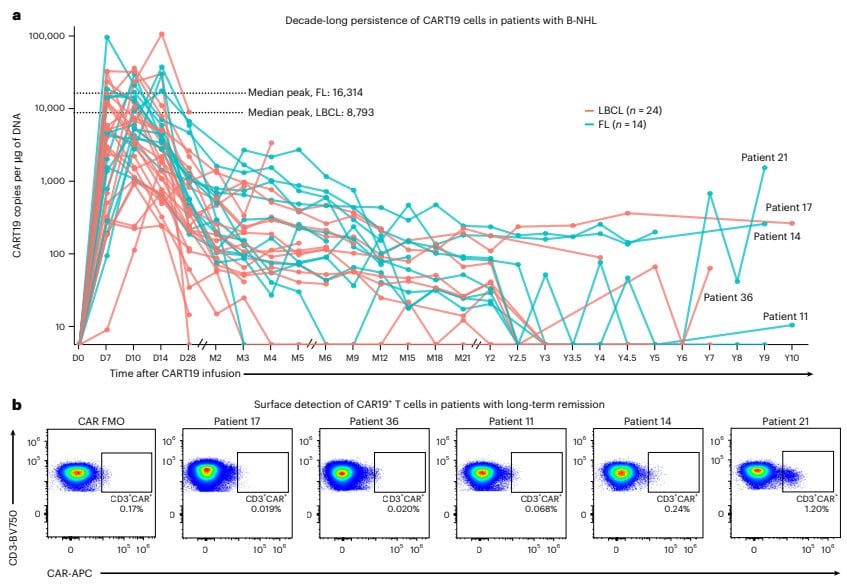
Among the 12 long-term responders who still had samples measurable five years after infusion, 8 had available samples. Of these, 5 (62.5%) still had detectable CAR transgene, with a median of 262 copies/µg DNA, ranging from 10 to 1567. However, flow cytometry clearly identified CAR+ T cells only in patient 21, accounting for 1.2% of CD3+ lymphocytes.
One notable correspondence was that the three patients with transgene copy numbers exceeding 200 all maintained complete and sustained B-cell aplasia, whereas the two patients with lower copy numbers showed B-cell reconstitution. This suggests an association between molecular persistence and functional activity.
The curve of patient 21 was particularly distinctive. CAR transgene peaked at day 14 (18,062 copies), then gradually declined and fell below the detection limit at year 4.5, yet showed two late expansions at year 7 and year 9.3, with CAR-T accounting for 1.2% of CD3+ T cells at the second expansion. At the time of the second expansion, the patient's nasal swab tested positive for rhinovirus/enterovirus.
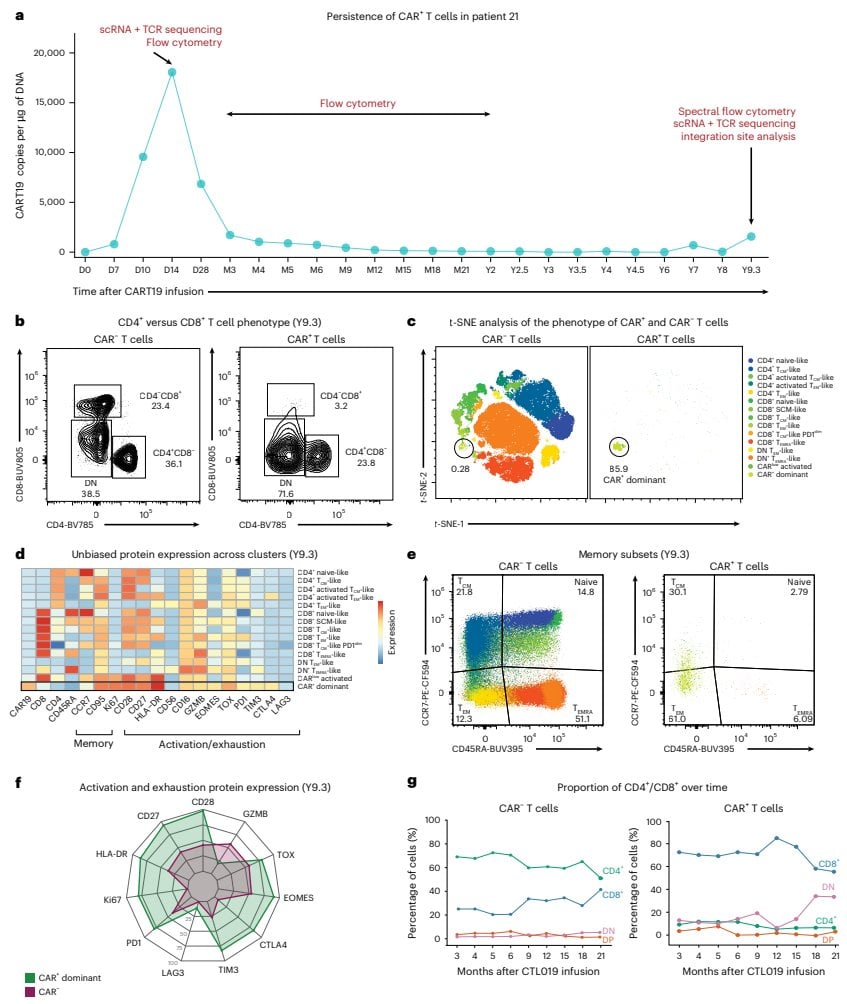
Phenotypically, the long-persisting CAR+ T cells in patient 21 were highly enriched for double-negative (CD4−CD8−) cells, accounting for 71.6%, compared with 38.5% among CAR− T cells; the CD8+ proportion was markedly lower. Unbiased clustering showed that 86% of CAR+ T cells clustered in the same dominant cluster, which displayed a CD45RA−CCR7−CD95+ effector memory-like phenotype, with higher expression of the proliferation marker Ki-67, activation marker HLA-DR, and checkpoint molecules PD-1, TIM-3, and CTLA-4, while granzyme B expression was lower than in CAR− T cells.
Longitudinal flow analysis showed that the double-negative proportion in the CAR+ compartment rose from 13.4% at month 3 to 33.9% at month 21, with a corresponding decline in CD8+; in contrast, double-negative T cells in the CAR− compartment remained stable at 1% to 5%. This indicates that double-negative CAR-T cells underwent selective expansion during long-term follow-up.
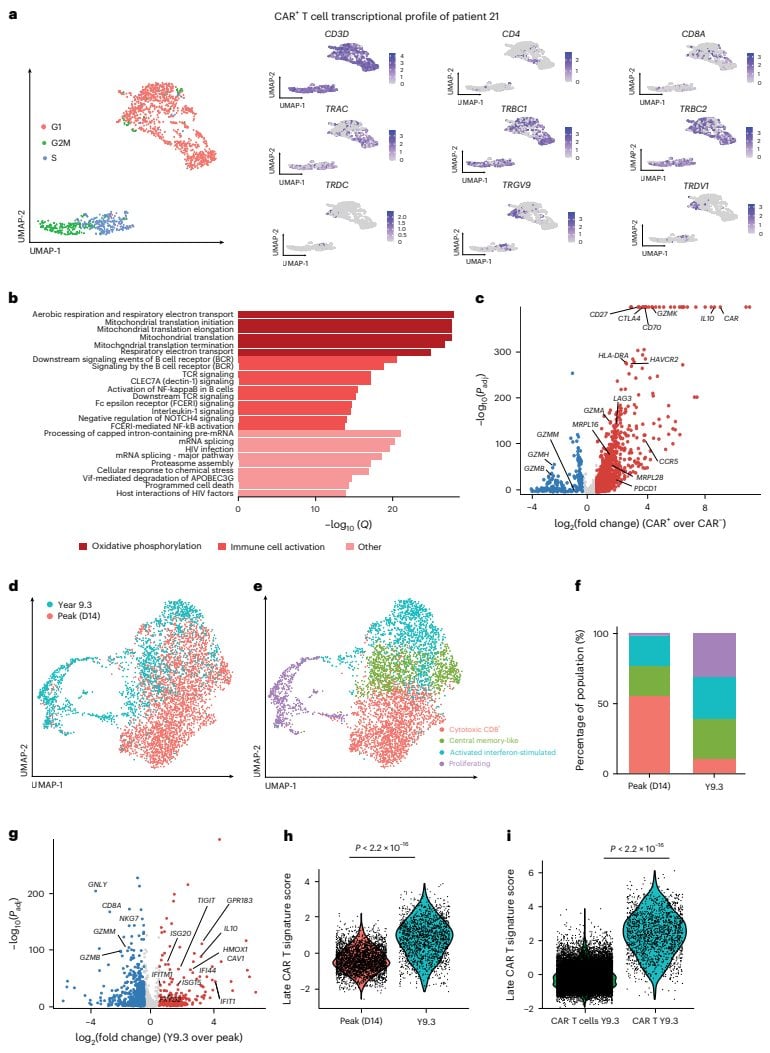
Single-cell transcriptomics further supported this picture. More than half of the CAR+ T cells at year 9.3 displayed an activated interferon-driven program, while co-expressing proliferation markers and retaining cytotoxic genes such as granzyme K, perforin, and NKG7. Compared with the day-14 peak, long-term cells significantly upregulated interferon-related genes and mitochondrial metabolic genes, and the vast majority were conventional αβ T cells, with only about 8% expressing γδ receptor genes.
Innovation: Oligoclonal Selection Rather Than Insertional Mutation
Clonality analysis yielded a clear conclusion. At the expansion peak, the CAR+ compartment contained 1593 unique clonotypes; by year 9.3, only 68 remained. Normalized Shannon entropy decreased from 0.95 to 0.38, whereas the entropy of CAR− T cells remained almost unchanged. One dominant clone (CSAGTWGTEAFF) accounted for nearly 70% of CAR+ T cells at year 9.3, whereas its frequency at day 14 was less than 0.1%.
Integration site analysis detected 111 unique insertion sites, also showing an oligoclonal distribution (Gini index 0.81), with 45% located in PACS1. However, the researchers noted that PACS1 is a common lentiviral integration preference site and was mainly found in the manufactured product rather than in post-infusion samples, and therefore more likely reflects vector insertion bias rather than a mechanism driving persistence. In other words, ten-year persistence arose from the selective survival of specific clones, rather than insertional mutation driving cell expansion.
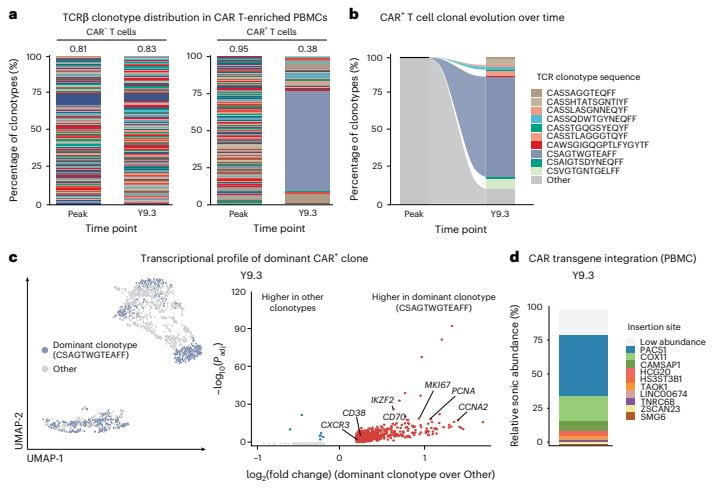
Cross-disease comparison showed that the CAR-T cells of patient 21 at year 9.3 were transcriptionally highly similar to long-term persisting cells in pediatric B-cell acute lymphoblastic leukemia and chronic lymphocytic leukemia, despite differing phenotypes (double-negative vs predominantly CD4+). This suggests that across different diseases and products, long-lived CAR-T may converge on a shared maturation trajectory.
Practical Implications: Benefits and Costs of Persistence
This study is the first to systematically describe decade-scale functional persistence of CAR-T cells in lymphoma. Clinically, it reinforces the association between persistence and long-term remission, and explains why 4-1BB-costimulated products show longer persistence in some patients.
However, the researchers did not simply equate persistence with benefit. Although patient 21 maintained remission, persistent B-cell aplasia and hypogammaglobulinemia required monthly intravenous immunoglobulin replacement, and persistent bronchiolitis appeared from year 9 onward. The authors propose that in settings of severe or recurrent infection, limiting long-term CAR-T persistence has a reasonable basis.
The study also clearly identified limitations: the sample size was limited, the in-depth analyses came mainly from a single patient, and mechanistic conclusions should be regarded as exploratory and hypothesis-generating. Whether persistence is a direct cause of disease control or an accompanying phenomenon of favorable host and product characteristics still requires prospective, systematically sampled large-cohort studies to answer.
Summary and Reflections
The value of this work lies not in proving the phenomenon that "CAR-T can persist for ten years" itself, but in dissecting persistence into observable phenotypic, transcriptional, and clonal features, and frankly presenting its two-sided nature: the same population of cells may be both the executor of immune surveillance and a source of late infection risk.
One question worth pursuing further is: if long-lived CAR-T cells gradually drift toward a double-negative phenotype under repeated antigen stimulation, can we preserve their surveillance function while installing a controllable "switch" for the cost of B-cell aplasia? This may be a direction that next-generation cell therapy design needs to address head-on.