


An in vivo BCMA CAR-T phase 1 study for relapsed/refractory multiple myeloma observed, over a maximum follow-up of 15 months, that 4 patients achieved an objective response rate of 100%, but only 1 patient maintained strict complete remission through 15 months, with a median progression-free survival of 4.0 months. Based on this extended follow-up data published in Nature Medicine in 2026, this article reviews its design, findings, and limitations.
Study Background: A Treatment Dilemma That Begins with "Waiting"
CAR-T therapy has rewritten the treatment landscape for hematologic malignancies, but its availability has always been constrained by the manufacturing process. According to a U.S. real-world study, fewer than 40% of patients with relapsed/refractory multiple myeloma actually received commercial BCMA CAR-T within 12 months.
There is also a risk of death during the waiting period. Long manufacturing cycles, high logistical requirements, and high costs together constitute the threshold of "whether it can be used at all."
In vivo CAR technology offers another approach: using viral or non-viral vectors to deliver the CAR directly to endogenous T cells within the patient's body. It transforms CAR-T from a "personalized custom product" into a "ready-to-use treatment modality."
Over the past five years, such preclinical research has advanced rapidly, and the number of registered clinical trials has also been increasing. However, clinical data remain scarce, and long-term follow-up data are almost nonexistent.
Study Objective: Answering "How Long Can It Be Maintained"
This phase 1, single-arm, open-label study was conducted at a hospital in Wuhan to evaluate the safety, tolerability, and preliminary efficacy of a lentiviral vector-based in vivo CAR-T targeting BCMA.
Short-term data from 4 patients, with follow-up to 3 months, had been reported previously. This update focuses on long-term safety, durability of remission, and subsequent treatment after disease progression.
The study registration number is NCT06691685. Because the sponsor was acquired, the trial has been terminated and no new patients have been enrolled.
Study Methods (Brief): No Lymphodepletion, No Cell Collection
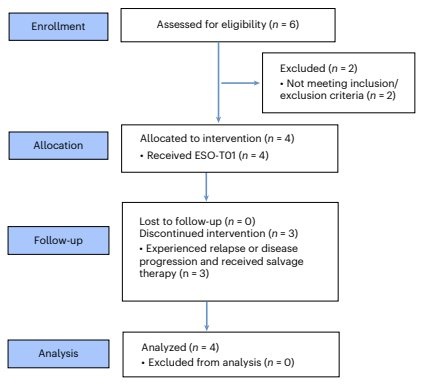
From November 2024 to February 2025, a total of 6 patients were screened, 2 were excluded for not meeting criteria, and ultimately 4 patients received treatment.
The median age of the patients was 63 years, with an equal number of men and women, and a median of 4 prior lines of therapy. One patient was refractory to five drugs, and 1 patient had previously received BCMA-GPRC5D CAR-T. All 4 patients had extramedullary disease, and the largest measurable lesion diameter exceeded 5 cm in all cases.
The administration method was a single intravenous infusion, without leukapheresis and without lymphodepleting preconditioning. The primary endpoints were safety and tolerability, and secondary endpoints included efficacy, pharmacokinetics, and pharmacodynamics.
Safety was graded according to CTCAE 5.0, cytokine release syndrome (CRS) and immune effector cell-associated neurotoxicity syndrome (ICANS) were assessed according to ASTCT criteria, and efficacy was evaluated according to the 2016 IMWG criteria.
Core Findings: High Response Rate Coexisting with Short Remission Duration
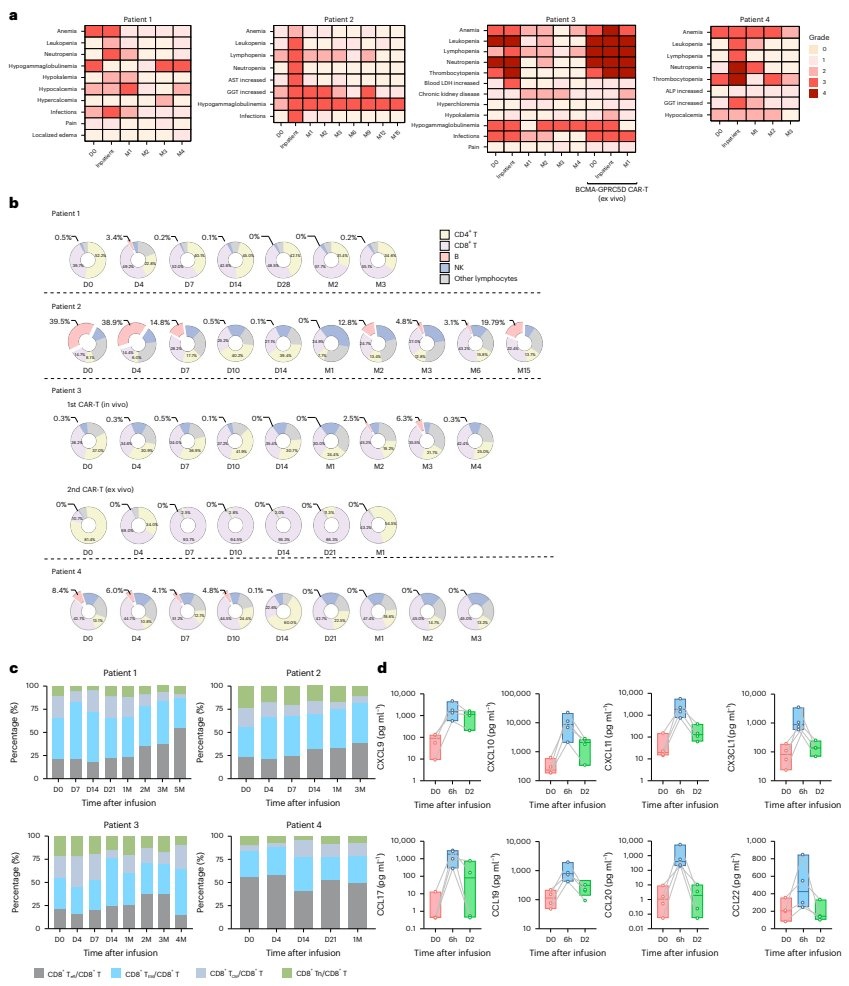
All 4 patients developed vector-related reactions, most commonly fever, hypoxia, and hypotension, corresponding to grade 1–3 CRS. One patient developed grade 1 ICANS. Grade 3–4 hematologic toxicities all occurred, including neutropenia (75%), leukopenia (50%), thrombocytopenia (50%), and lymphopenia (75%). Within 1 month, 3 patients recovered to grade 2 or below.
In terms of efficacy, 2 patients achieved strict complete remission (sCR) and 2 achieved partial remission (PR), for an objective response rate of 100%.
However, the durability of remission was suboptimal. Three patients relapsed or progressed at 5, 3, and 3 months after infusion, respectively, and all had extramedullary involvement, with 2 of them showing cerebrospinal fluid (CSF) involvement. Despite receiving salvage therapies such as chemotherapy or BCMA-GPRC5D bispecific CAR-T, the 3 patients ultimately died of infection, disease progression, and intracranial hemorrhage, respectively.
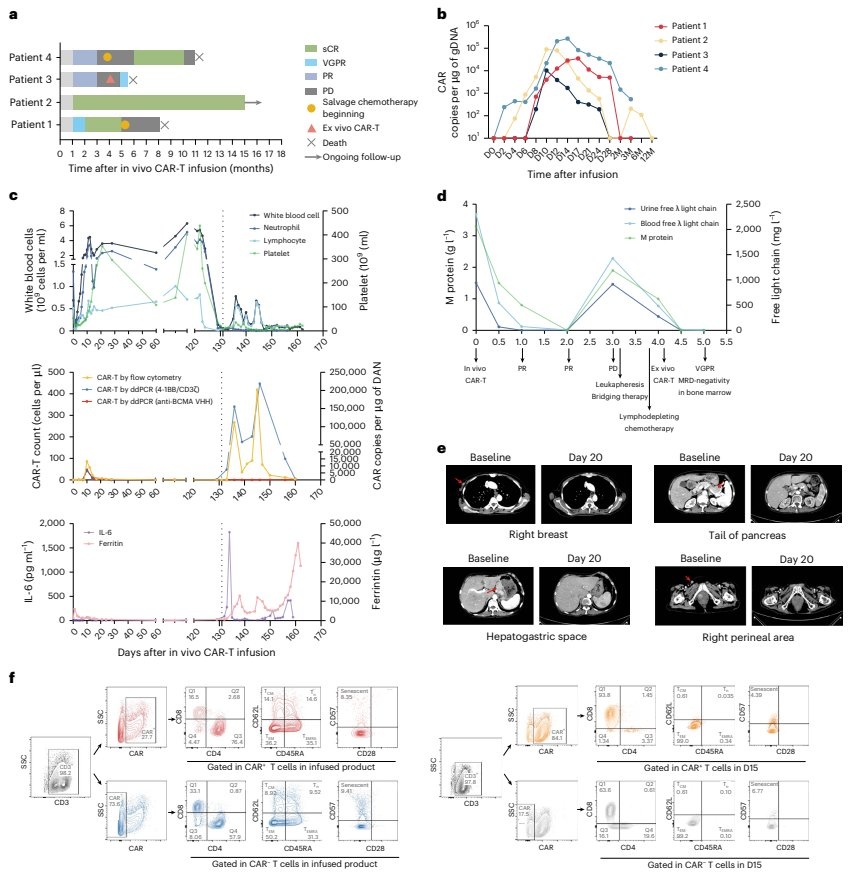
The only patient who maintained sCR through 15 months was patient No. 2. She had the lowest baseline tumor burden, with only two paraosseous lesions, did not receive glucocorticoids during the expansion phase, had CAR-T cells predominantly of the naive and central memory phenotypes, and had a secondary expansion signal still detectable by qPCR at month 3. The authors suggest that younger age and fewer prior lines of therapy may together have contributed to a more favorable T-cell state.
CAR-T kinetics suggested a pattern of relapse: patients No. 1 and No. 3 progressed when CAR-T cells were undetectable, whereas patient No. 4 had persistent CAR-T cells in the CSF but failed to clear the tumor, with a significant increase in CSF tumor cells at month 3.
Innovations or Breakthroughs: First Long-Term Follow-up Picture
This is currently the longest follow-up report of in vivo CAR-T therapy for multiple myeloma, extending up to 15 months.
The study also provided several observations that had previously been lacking. Within hours after infusion, all patients developed transient lymphopenia, while neutrophil and platelet counts showed no significant changes. Serum chemokines such as CXCL9, CXCL10, and CXCL11 increased 100- to 1000-fold within 6 hours and fell back by day 2, coinciding with lymphocyte recovery. The authors therefore speculate that chemokines released by immune activation drove T-cell migration.
Regarding immunogenicity and genotoxicity, anti-VSVG antibodies were detectable at baseline in some patients and increased mildly after infusion, but the only patient with durable remission happened to have baseline anti-VSVG antibodies. Integration site analysis showed that the top 10 clones each accounted for less than 10%, indicating a polyclonal pattern; the proportion of integration sites related to genes associated with tumors or prior adverse events did not exceed 3% in any case, and no high-risk integration events were observed.
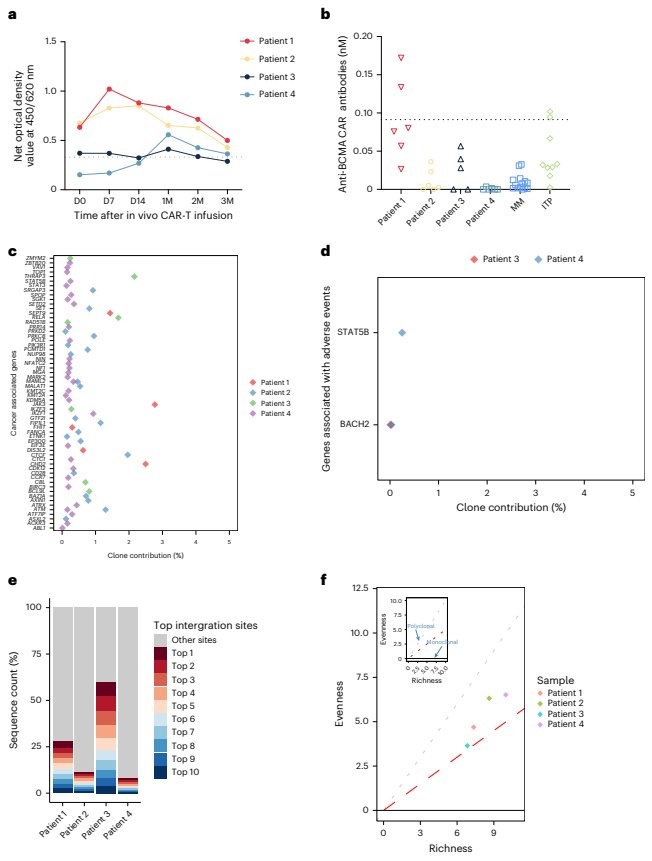
Another noteworthy detail is that patient No. 3, after progression on in vivo CAR-T, received ex vivo BCMA-GPRC5D CAR-T and achieved VGPR. This indicates that prior in vivo CAR-T treatment does not preclude the collection, manufacturing, and expansion of subsequent conventional CAR-T.
Practical Implications: Durability of Remission Is the Next Threshold
For clinical practice, these data indicate that in vivo CAR-T is feasible in a heavily pretreated population and, because lymphodepletion is not required, hematologic toxicity recovery is relatively faster. In the KarMMA study, the proportions of prolonged grade 3–4 neutropenia and thrombocytopenia were 41% and 48%, respectively, lasting more than 1 month; in this study, most hematologic toxicities improved within 1 month.
However, durability of remission remains the core shortcoming. The authors analyze that extensive baseline extramedullary disease, CSF involvement, poor T-cell status, as well as the local immunosuppressive microenvironment and antigen downregulation, may all contribute to resistance. Biopsy of the extramedullary lesion in patient No. 3 showed BCMA expression of 50%, compared with 0% in the bone marrow, suggesting that antigen escape needs to be systematically evaluated in prospective studies.
The study limitations are also clear: only 4 samples, mechanistic analyses mostly post hoc exploratory, no formal statistical testing, and some conclusions require validation by prospective studies with larger scale and longer follow-up.
Summary and Reflections
This extended follow-up advances the discussion of in vivo CAR-T from "whether it can work" to "how long it can be maintained." The 100% objective response rate is noteworthy, but the median progression-free survival of 4.0 months reminds us that for ready-to-use CAR-T to truly change clinical practice, continued optimization is needed in vector design, T-cell fitness, and antigen escape monitoring.
One question worth considering is: if the durability of remission depends mainly on host T-cell status and tumor burden, how should the eligible population for in vivo CAR-T be defined? Should it intervene at earlier lines of therapy, or focus on patients who cannot wait for manufacturing? This may be a question that the next generation of research needs to answer.