


A study published in Nature Medicine proposes the uRARE-seq method, which performs targeted capture and sequencing of urinary cell-free RNA fragments, achieving non-invasive detection of localized bladder cancer with 95% sensitivity and 90% specificity across 683 samples, and can predict patients' likelihood of responding to intravesical BCG instillation or chemotherapy based on pre-treatment urinary immune and proliferation features. The study used a case-control design and still requires prospective validation.
Research Background
Bladder cancer surveillance has long relied on cystoscopy and urine cytology. The former is an invasive procedure, while the latter has limited sensitivity for low-grade tumors, and the figures often cited in the literature are not ideal. Urine is in direct contact with the tumor and can be collected non-invasively, so it has long been regarded as an ideal source of liquid biopsy samples.
Previous urine RNA studies mostly focused on a small number of genes with narrow coverage. The researchers' hypothesis was that if broader expression profiling of urinary cell-free RNA (cfRNA) could be performed, it might capture tumor-derived transcripts with greater sensitivity and specificity. This idea formed the starting point of the study.
Research Objectives
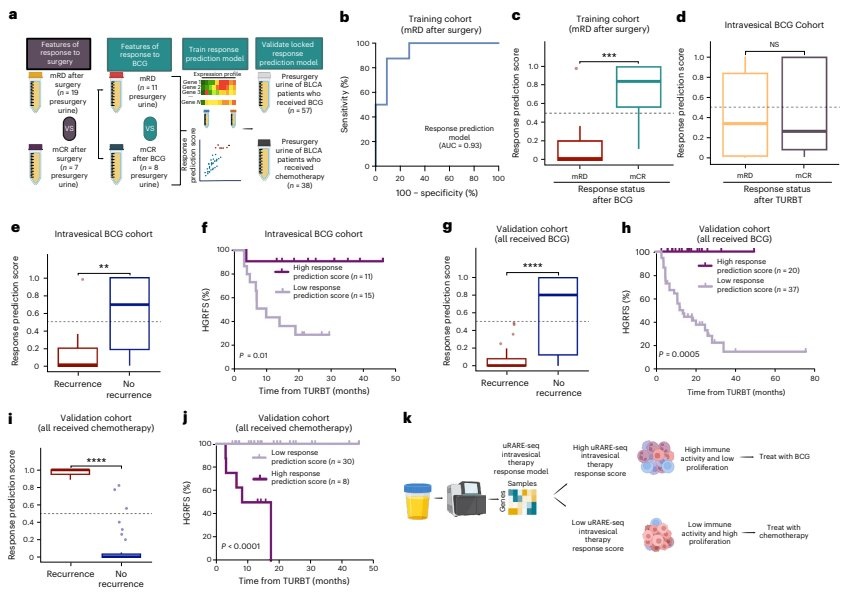
The research team sought to answer questions at three levels. First, whether a stable, reproducible urinary cfRNA sequencing workflow could be established and whether its signal could be shown to derive mainly from genitourinary system tissues. Second, whether this method could accurately detect bladder cancer and how it would compare with existing urine detection methods. Third, and more translationally valuable: whether the pre-treatment urinary transcriptome could distinguish which patients benefit from surgery and which need to rely on intravesical Bacillus Calmette–Guérin (BCG) immunotherapy, and predict their likelihood of responding to BCG or chemotherapy.
Research Methods (Brief)
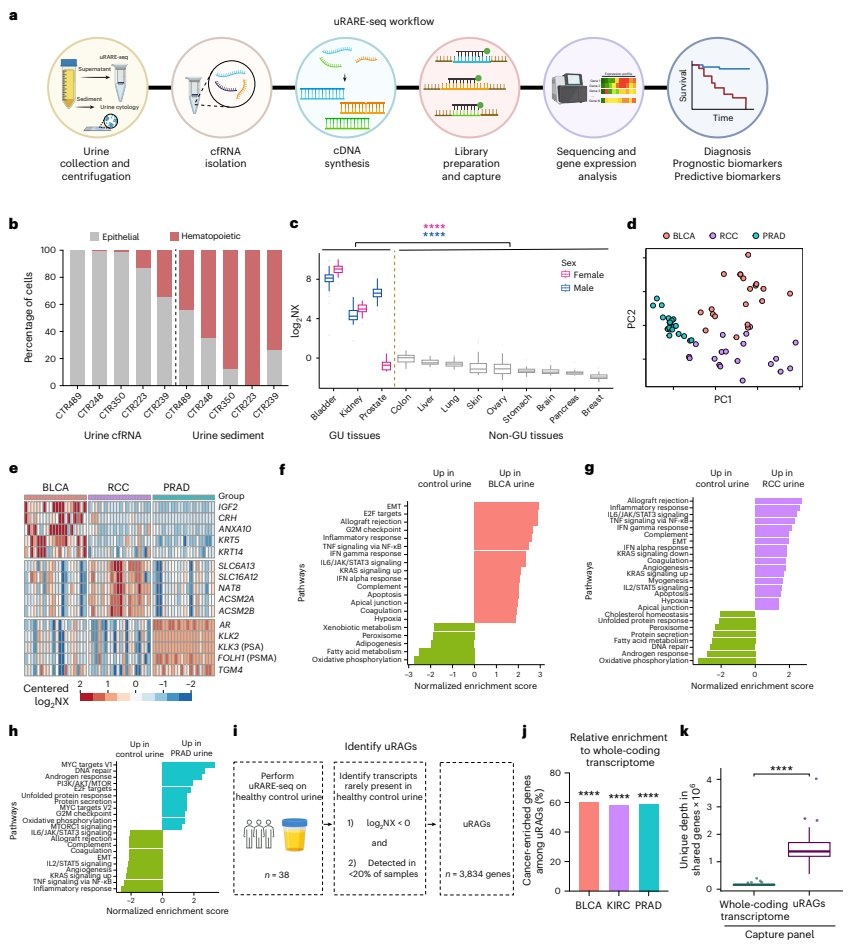
The researchers adapted a hybridization capture sequencing strategy originally developed for plasma cfRNA to urine, creating uRARE-seq. Because cfRNA in urine supernatant is highly fragmented, the method required optimization for short fragments; after comparing different extraction protocols, the silica column method performed better in terms of concentration, fragment length, and expression profile.
A key design element was the "rare-abundance gene" capture panel. The researchers identified 3,834 low-expression or rarely occurring genes (uRAGs) from urine of 38 non-cancer controls, then supplemented these with housekeeping genes, urologic tumor-related genes, and immune deconvolution genes to construct a custom panel of 4,782 genes. Compared with a whole coding transcriptome panel, this panel detected more genes at the same sequencing depth.
The team then used elastic net machine learning to build a bladder cancer detection model and locked a threshold in an independent validation cohort to evaluate performance; they also trained models for grade, muscle-invasive status, and intravesical treatment response prediction.
Key Findings
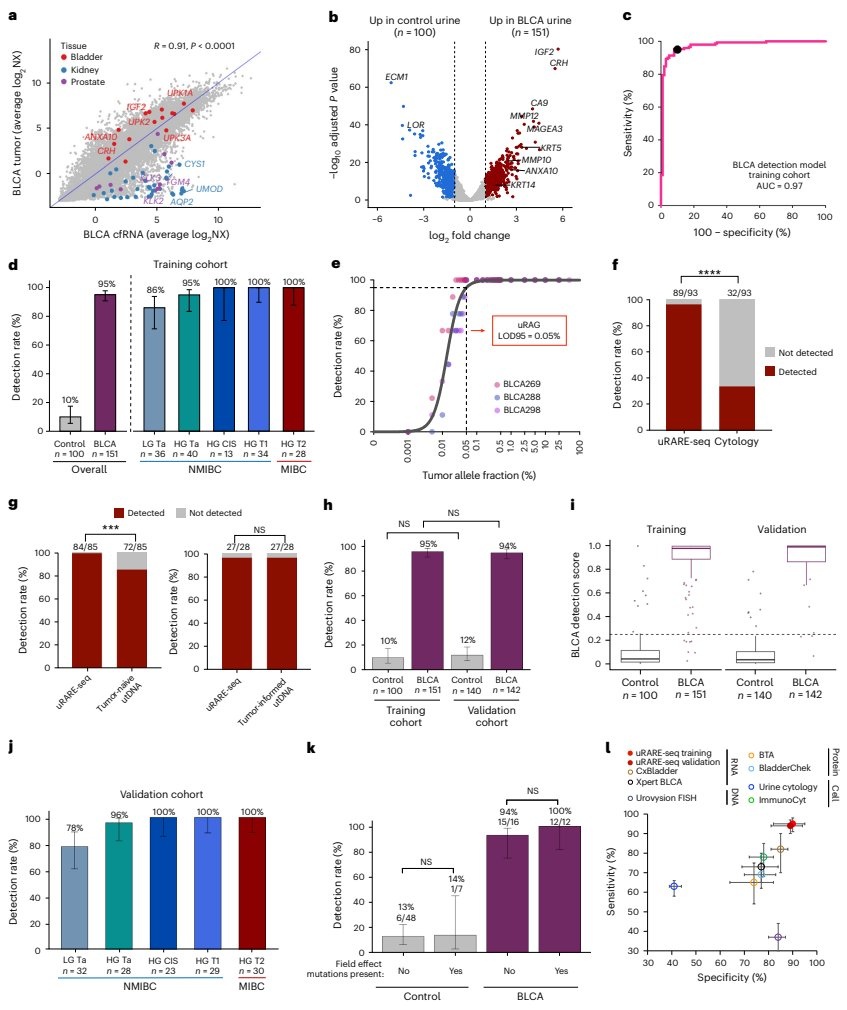
In the training cohort (100 controls, 151 bladder cancer cases), the detection model achieved an area under the curve (AUC) of 0.97, with 95% sensitivity at 90% specificity. Sensitivity was high across grades and stages: 86% for low-grade Ta, and 100% for carcinoma in situ, high-grade T1, and T2. Performance was similar in the independent validation cohort (140 controls, 142 bladder cancer cases).
Compared with commonly used clinical methods, among 93 paired samples uRARE-seq detected 89 cases (95.7%), whereas urine cytology detected only 32 (34.4%); cytology detected no low-grade Ta tumors, while uRARE-seq detected 90% of them. Sensitivity was comparable to tumor-informed urinary tumor DNA methods but was not affected by field-effect mutations.
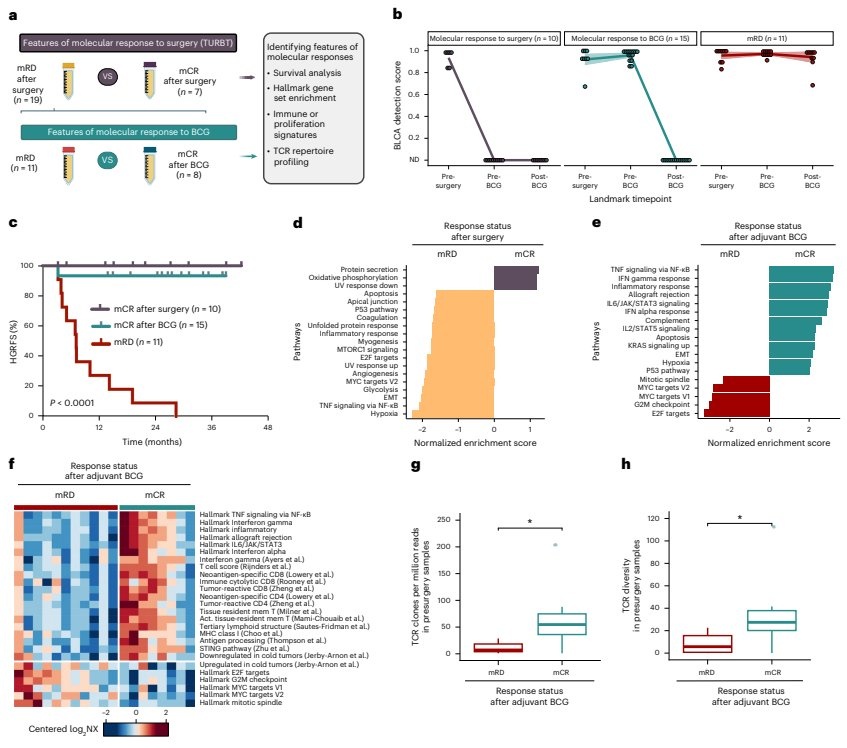
Among 36 patients with intermediate- and high-risk non-muscle-invasive bladder cancer, clearance of urinary cfRNA after surgery and after BCG induction was significantly associated with recurrence risk. Patients in whom tumor cfRNA remained detectable after BCG had significantly worse high-grade recurrence-free survival (HR=41.17).
More noteworthy were the transcriptomic features of responders. Patients who achieved molecular complete remission after BCG had pre-treatment urine enriched for immune signals including T cells, interferon response, and inflammatory response, whereas non-remitters were enriched for proliferation-related pathways. T-cell receptor analysis showed that BCG responders had more T-cell clones and higher diversity, a difference that was not present among surgery responders.
Innovations or Breakthroughs
The first is the choice of analyte. Compared with urinary tumor DNA, cfRNA carries expression information rather than only mutation information, and can therefore characterize tumor biology, including grade, muscle-invasive propensity, and immune microenvironment status.
The second is the methodological "removal of tumor dependence." The model can perform single-sample classification without paired tumor tissue or additional urine samples, making it easier to implement in real-world testing settings.
The third is the indirect observation of BCG response mechanisms. Previous BCG response biomarkers have been difficult to validate, partly because it is impossible to distinguish whether a patient was cured by surgery or by BCG. This study used molecular remission stratification by cfRNA to analyze the two types of responders separately, thereby isolating BCG-specific immune features.
Practical Implications
For clinical practice, this method suggests several potential uses: non-invasive screening and surveillance, assessment of minimal residual disease after surgery, and reference for treatment selection before therapy. In the study, the pre-treatment response prediction model achieved an AUC of 0.93 in the BCG cohort and showed an association with recurrence risk in an independent chemotherapy cohort—patients with low likelihood of BCG response were instead more likely to benefit from chemotherapy, consistent with the clinical observation that durable responses can still be achieved with chemotherapy after BCG failure.
For translational research, it provides a reproducibly obtainable, longitudinally trackable window into the genitourinary transcriptome. The researchers also noted that BCG supply shortages occur from time to time, and that pre-identifying patients more suitable for first-line chemotherapy would have certain practical value.
The limitations are equally clear: the case-control design, samples from two geographically adjacent institutions, limited sample sizes for some analyses, and non-randomized treatment groups all mean that the conclusions need to be confirmed in prospective cohorts.
Summary and Reflections
The value of this work lies not in the level of any single metric, but in demonstrating the potential of urinary cfRNA as a "readable expression profile" rather than "countable mutations": it advances liquid biopsy from "is there tumor" to "what biological state is the tumor in, and what treatment might it respond to." From detection to classification to treatment response prediction, if this path can hold up in prospective studies, it may change the pace of follow-up and decision-making for non-muscle-invasive bladder cancer.
One question worth considering: when a single pre-treatment urine sample can indicate the "foundation" of immune response, how should we define the boundary between "suitable for BCG" and "suitable for chemotherapy"? Should we continue to rely mainly on clinicopathological stratification, or should molecular features participate in decision-making? This depends both on the reproducibility of the assay and on whether we are willing to accept a probabilistic rather than deterministic logic of treatment selection.