


A study published in the Journal of Experimental Medicine (J. Exp. Med. 2026) performed single-cell resolution spatial transcriptomic analysis of kidney biopsies from 8 patients with newly diagnosed, untreated MPO-ANCA-associated glomerulonephritis, and found that injured proximal tubules, neutrophils, and TREM2⁺ macrophages form a spatial microenvironment around glomeruli; animal experiments showed that combinations of anti-MPO monoclonal antibodies recognizing different epitopes can enhance neutrophil activation via FcγR and induce crescentic glomerulonephritis. The evidence comes from cross-sectional human samples and mouse models, and is not yet a conclusion about clinical efficacy.
Research background: how antibodies "find" tissue
Autoantibody-mediated inflammation is a fundamental mechanism of organ-specific autoimmune disease. But a long-unresolved question is: after pathogenic antibodies enter the circulation, how do they initiate local immune activation within a specific organ?
ANCA-associated glomerulonephritis provides a clear research setting. It occurs primarily as a primary renal manifestation rather than as a secondary consequence of systemic inflammation. Antibodies against myeloperoxidase (MPO) can activate neutrophils, prompting them to produce reactive oxygen species and neutrophil extracellular traps.
More complex still, anti-MPO antibodies can recognize multiple epitopes on the MPO molecule. Whether epitope diversity affects the intensity of neutrophil activation previously lacked tissue-level evidence.
Research objective: seeing the "early events" clearly
Previous spatial omics studies mostly sampled already-formed inflammatory lesions, making it difficult to capture the disease initiation stage. The goal of this study was: to localize the earliest immune–epithelial interactions in the kidneys of newly diagnosed patients who had not received immunosuppressive treatment, and to verify their causality using mechanistic models.
The study simultaneously asked two questions: whether injured epithelial cells actively recruit immune cells; and whether the epitope combination pattern of antibodies determines the degree of neutrophil activation.
Research methods (brief)
The human portion included 4 healthy donor kidneys and 8 patients with newly diagnosed MPO-ANCA-positive microscopic polyangiitis. FFPE sections underwent spatial transcriptomics on the 10x Genomics Xenium platform with a 5000-gene targeted panel, retaining a total of 410,222 cells. The study defined "microenvironments" by the cell-type composition within a 50-micrometer radius, and performed pseudotime trajectory analysis on 103 glomerular microenvironments.
In the mechanistic portion, researchers immunized MPO-deficient mice and screened out three anti-MPO monoclonal antibodies, resolved their epitopes by cryo-electron microscopy, and induced nephritis in 129S6 mice by intraperitoneal injection of antibody combinations. They then used "one-arm" antibodies (retaining antigen binding while reducing FcγR engagement) for intervention validation.
Core findings: an ordered injury circuit
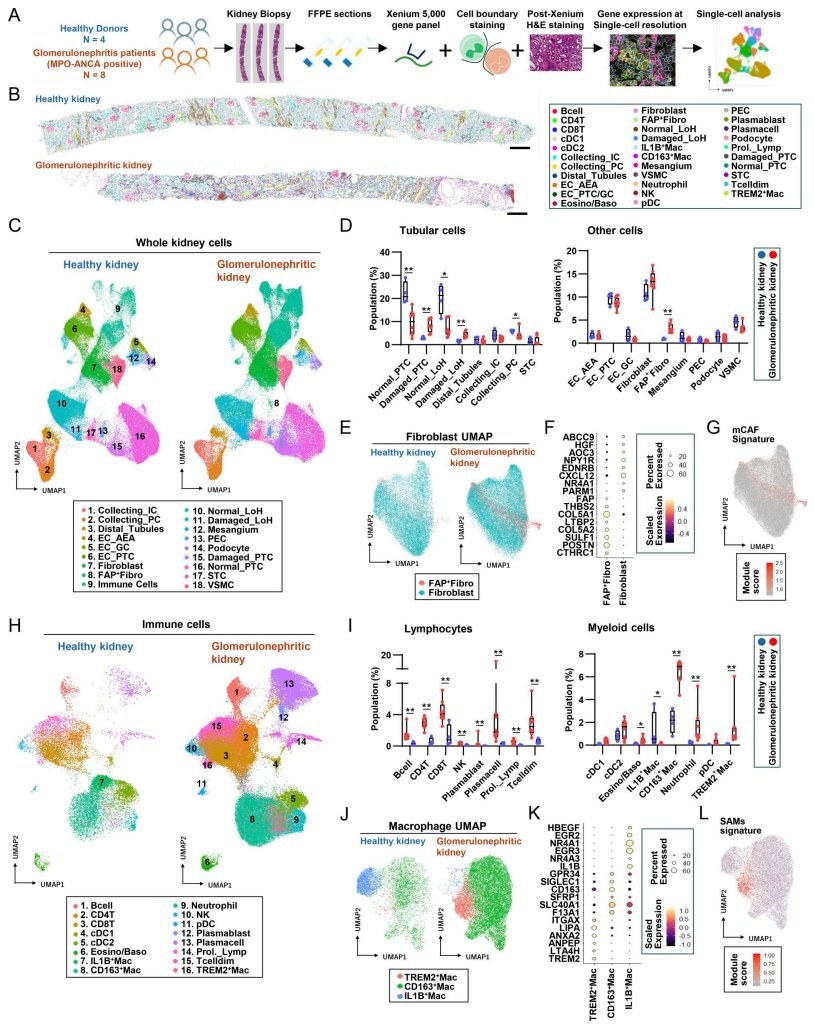
Patient kidneys showed marked cellular compositional reorganization: HAVCR1-high injured proximal tubular cells, ITGB6-high injured loop of Henle cells, FAP⁺ fibroblasts, and TREM2⁺ macrophages were significantly expanded. The latter two resembled matrix cancer-associated fibroblasts and scar-associated macrophages, respectively, in their transcriptional programs.
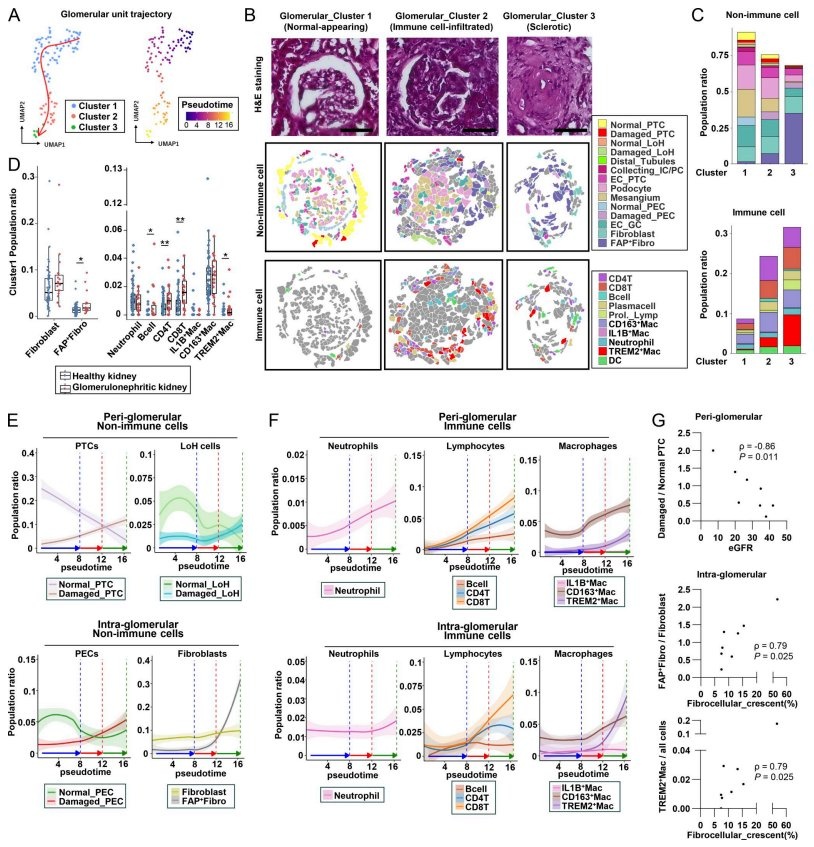
Spatial analysis identified 11 classes of microenvironments, among which injured glomeruli, injured proximal tubules, and lymphocyte-enriched microenvironments were significantly increased in patients. Pseudotime of the periglomerular region showed: at the stage when glomeruli were still histologically normal, injured proximal tubules had already increased, and neutrophils and lymphocytes had begun to accumulate; progressing to the immune cell infiltration phase, CD4⁺ and CD8⁺ T cells and B cells further accumulated; the sclerotic phase was dominated by expansion of TREM2⁺ macrophages.
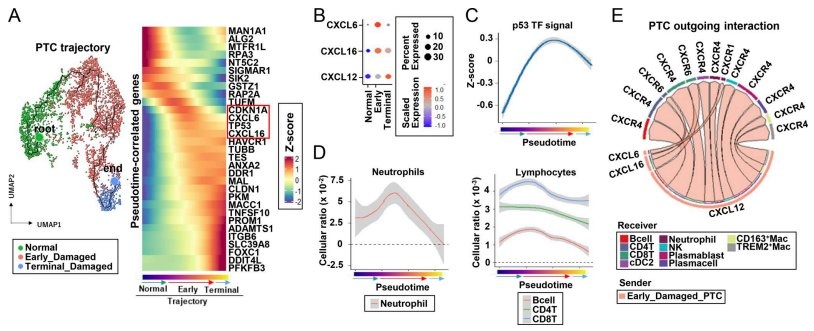
Injured proximal tubules upregulated CDKN1A, TP53, and the chemokines CXCL6 and CXCL16. Cell communication analysis suggested that CXCL6–CXCR1 recruits neutrophils and CXCL16–CXCR6 recruits T cells. Among these, CXCL6 upregulation was specific to the early injury state.
Neutrophils within the microenvironment exhibited a distinctive transcriptional state: enrichment of type II interferon-stimulated genes (such as CIITA, CYBB, IFIT3), elevated CXCR1/CXCR2 and FcγR expression, and enhanced FcγR downstream signaling activity. This state closely resembled a subset of neutrophils in peripheral blood that is more sensitive to ANCA.
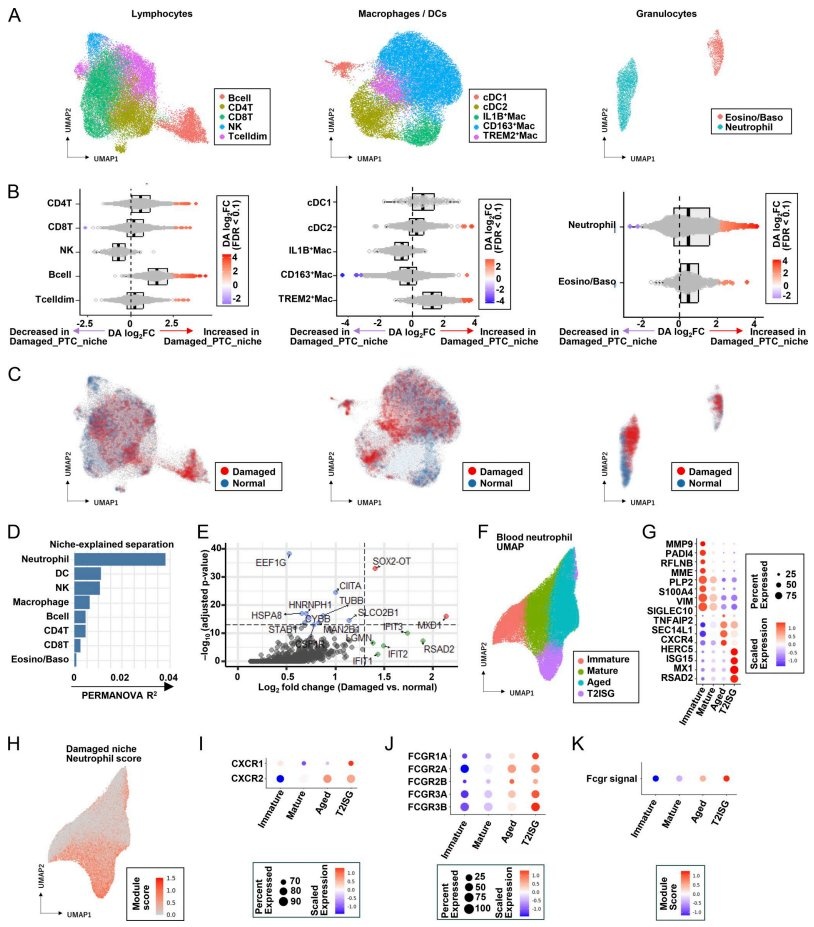
In mechanistic validation, 9 of 23 patient sera recognized multiple MPO fragments, and their BVAS scores were significantly higher. In mouse experiments, single antibodies administered alone did not cause obvious nephritis, whereas combinations of two or three antibodies recognizing different epitopes could induce pauci-immune crescentic glomerulonephritis.
Innovations or breakthroughs
This study advances the field in three respects.
First, it moves "antibody pathogenicity" from the serological level to the spatial tissue level, proposing that periglomerular proximal tubules are the hub connecting neutrophil activation with subsequent immune and stromal remodeling.
Second, it uses cryo-electron microscopy to demonstrate that the value of epitope combinations lies not in "stronger binding" but in the fact that the binding geometry of antibodies on the MPO surface alters the spatial arrangement of the exposed Fc segments, thereby favoring FcγR clustering. This provides a structural explanation for "multi-epitope recognition being associated with disease activity."
Third, one-arm antibodies, while retaining antigen specificity, weakened FcγR engagement, failed to induce reactive oxygen species, and reduced proteinuria and crescent formation in an adoptive transfer model, indicating that FcγR-dependent neutrophil activation is an intervenable node.
Practical implications
Clinically, periglomerular injured tubular signals were associated with lower eGFR, suggesting they may serve as candidate indicators of a pre-fibrotic state; however, the authors explicitly state that, affected by biopsy spatial heterogeneity, these correlations need validation in larger cohorts.
For translational research, the study suggests that ANCA-associated nephritis both shares a conserved "maladaptive repair" program and carries the disease-specific feature of antibody-driven neutrophil recruitment. This provides a mechanistic basis for early intervention strategies.
The boundaries of the study should be emphasized: the human data are a cross-sectional snapshot, and pseudotime is a computational inference rather than a direct temporal measurement; the mouse model relies on the innate immune reactivity of a specific strain; and the three one-arm antibodies do not represent all epitopes of the polyclonal anti-MPO repertoire.
Summary and reflections
This study dissects autoantibody pathogenicity into a spatially ordered process: epithelial stress first establishes a chemokine field, neutrophils within it are armed by FcγR signaling, immune infiltration then extends into the glomerulus, and finally fibroblasts and TREM2⁺ macrophages complete the remodeling.
A question worth continuing to pursue is: if epithelial stress and neutrophil infiltration may be initiated in parallel and then mutually amplify, at which step should the "earliest window" for intervention fall? The answer to this question may determine the design logic of future early treatment strategies.