



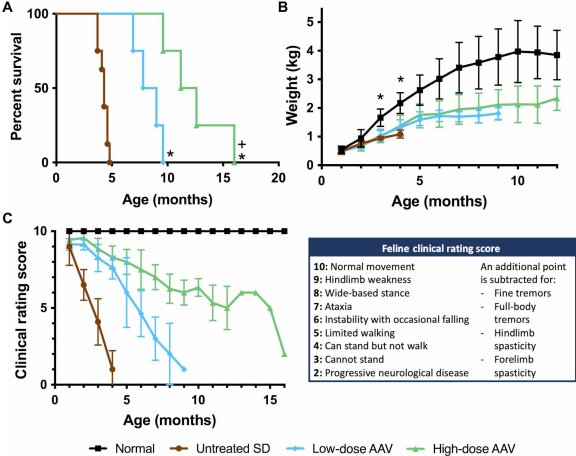
Sandhoff disease (SD) is caused by defects in the HEXA/HEXB genes, leading to Hex enzyme deficiency and accumulation of GM2 ganglioside in lysosomes. Previous studies mostly delivered AAV via intracerebral or cerebrospinal fluid routes, but these are highly invasive. This study instead used intravenous injection of a bicistronic AAV9 vector to treat a cat model of SD before symptom onset (at approximately 1 month of age). The core contradiction lies in the fact that intravenous delivery must cross the blood-brain barrier, and the efficiency of co-expression of the two subunits is difficult to guarantee.
Bicistronic Design: The Necessity of a Single Vector
The study used a single AAV9 vector, with a CMV enhancer in the center and chicken β-actin promoters arranged in opposite orientations on either side, separately driving Hex α and β subunit cDNAs. The manufacturing logic of this design is clear: if two independent vectors were used, dilution in the bloodstream after intravenous injection would make the probability of a single cell being co-transduced by both vectors extremely low. HexA (αβ) is the only active form that degrades GM2, so both subunits must be expressed in the same cell.
Low dose (5×10¹³ vg/kg) extended survival from 4.3 months to 8.3 months, and high dose (2×10¹⁴ vg/kg) reached 12.4 months. The high-dose group showed no generalized tremor, whereas 3 of 4 in the low-dose group had onset delayed until 6.8 months.
Manufacturing Contradiction Between Tissue Distribution and Expression Efficiency
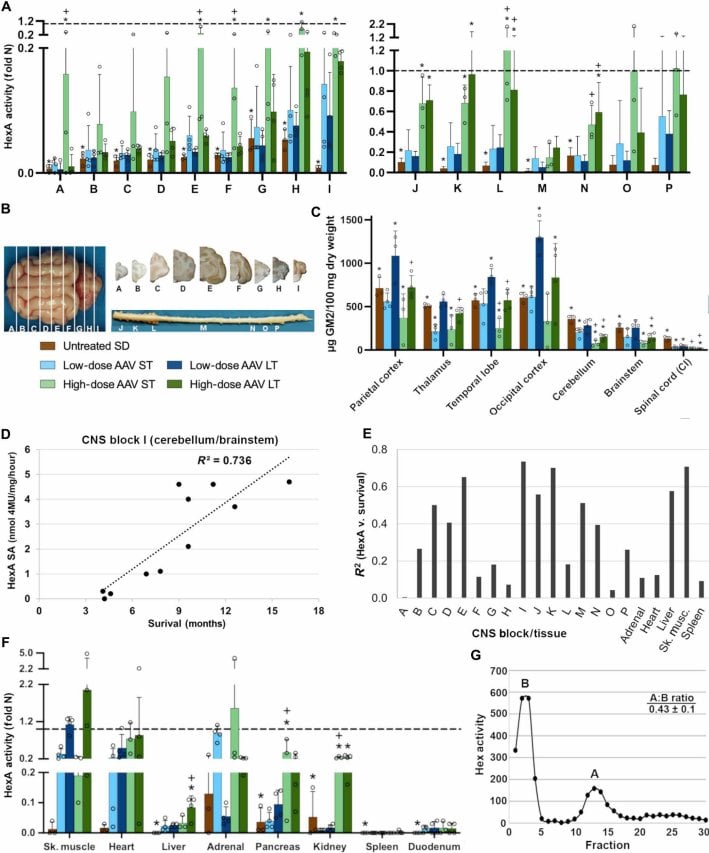
Vector distribution data showed the highest concentration in the cerebral cortex (0.050–9.658 vg/diploid genome), with lower levels in the cerebellum, brainstem, and spinal cord. However, the liver had the highest vector copy number, yet HexA activity never exceeded 0.09 times normal. After calculating the "specific activity/vector genome" ratio, the ratios in brain, spinal cord, skeletal muscle, and heart were 23.0–139.8 times that of the liver.
This discrepancy points to a key issue at the manufacturing level: vector genome abundance does not equal functional protein output. The authors noted that this vector lacks the WPRE element, whereas WPRE can enhance expression in the liver by up to 5.8 times. In addition, the cat liver may itself be unfavorable for the expression of certain AAV designs. For process development, the trade-off between tissue-specific promoters or expression-enhancing elements directly affects the therapeutic output per unit of vector.
Short-Term Correction and Long-Term Decline
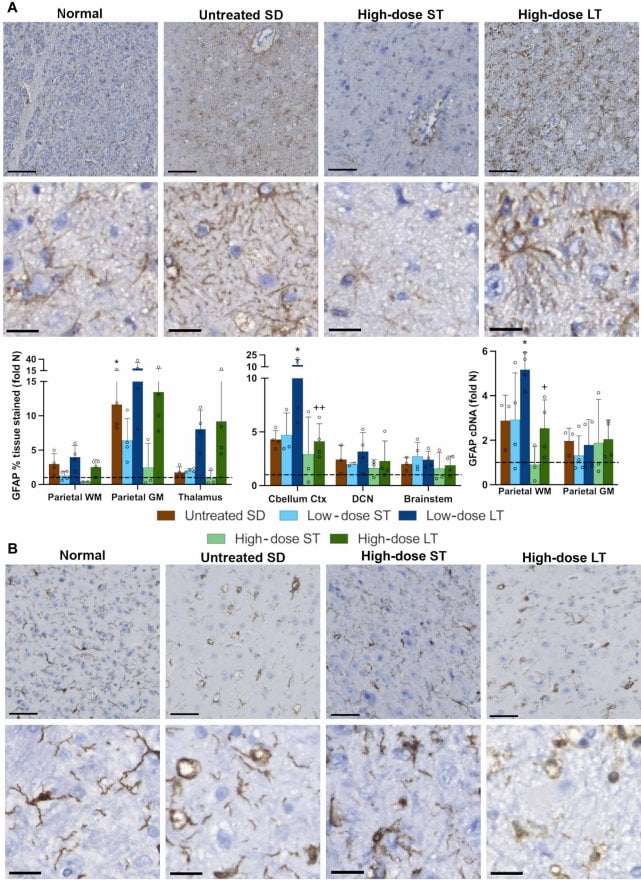
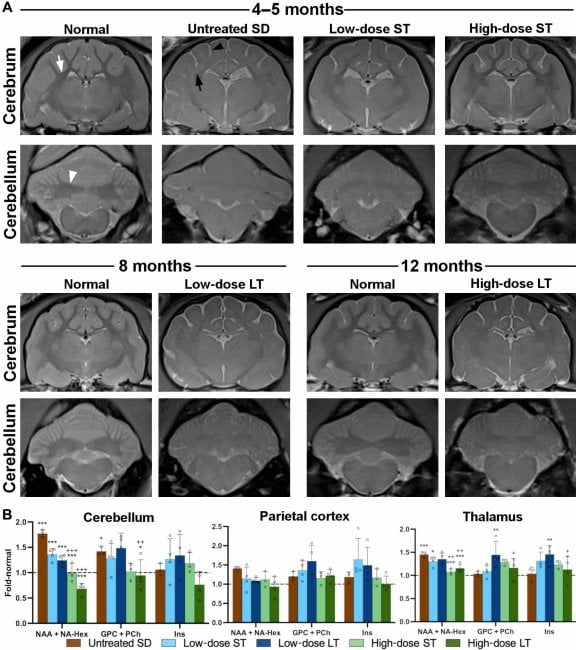
At 16 weeks, GFAP staining, Iba1 morphology, and the number of Olig2-positive cells in the high-dose group all approached normal. However, during long-term follow-up (to the humane endpoint), astrocyte and microglial morphology again approached that of the untreated group, and inflammation was only temporarily reversed.
At the same time, vector copy number decreased in almost all CNS regions from the short-term to the long-term group, possibly related to loss through division of transduced cells or immune responses. All treated cats developed AAV9 antibody titers (1:1000–1:256,000), which means that re-administration may be ineffective or even dangerous.
Implications for AAV Preparation and Purification Processes
The dose-dependent effect in this study is clear, but the high-dose group still did not fully normalize all indicators. From a process perspective, several issues deserve attention: first, high liver uptake but low expression suggests that vector distribution in non-target tissues may crowd out the effective dose; second, long-term expression decline and vector genome loss involve the balance among vector purity, empty capsid rate, and transduction efficiency; third, antibody production limits repeated administration, requiring the vector quality for a single administration to be as high as possible.
In purification processes, how to reduce the proportion of empty capsids and improve the efficiency of intact genome packaging directly relates to the functional output per unit vg. The decoupling phenomenon between tissue distribution and expression efficiency also suggests that process evaluation cannot rely only on vector copy number, but must be combined with functional protein activity.
One open question: when intravenously delivered vector accumulates substantially in the liver but does not express, should the process side prioritize optimizing tissue targeting, or improving single-cell transduction efficiency?

