



A preclinical study published in Science Translational Medicine used split intein protein trans-splicing and a muscle-tropic AAV vector to reconstruct full-length dysferlin in an LGMDR2 mouse model, with improvements in muscle strength and pathology observed at both early and late stages of disease. The study also showed that this strategy outperforms the conventional dual-vector DNA homologous recombination approach in terms of protein restoration efficiency.
A Gene Therapy Problem Stuck at the Packaging Limit
Limb-girdle muscular dystrophy R2 (LGMDR2, formerly LGMD2B) is caused by mutations in the DYSF gene. This gene encodes dysferlin—a 237 kDa sarcolemmal repair protein containing seven calcium-dependent C2 domains, two ferlin domains, and a C-terminal transmembrane domain.
In the absence of dysferlin, muscle fibers cannot effectively repair sarcolemmal damage caused by mechanical activity, leading to progressive muscle atrophy, inflammation, and weakness.
Gene replacement therapy appears to be a straightforward path. But the problem is this: the dysferlin cDNA is 6.2 kb long, while the packaging limit of AAV vectors is approximately 4.7 kb.
The difference is not large, yet it is enough to make the full-length protein "not fit."
Truncated "micro-dysferlin" versions have been attempted, but their function and localization are both suboptimal. The full-length protein is what is needed for therapy.
Two Dual-Vector Routes: DNA Recombination and Protein Splicing
To circumvent the packaging limit, the field has previously relied primarily on homologous recombination at the DNA level: two AAVs carry the 5′ and 3′ sequences respectively, and the complete open reading frame is assembled through tandem recombination of the vector genomes.
This strategy has already entered human intramuscular injection studies (NCT02710500), but it has several inherent shortcomings: high viral doses required, limited recombination efficiency, and the potential for aberrant transcripts arising from non-specific recombination.
The alternative proposed in this study is protein trans-splicing (PTS). It does not rely on DNA recombination; instead, at the post-translational level, it uses split inteins to seamlessly join two polypeptide halves.
The modular domain architecture of dysferlin and its cytoplasmic N-terminus make it suitable for splitting without disrupting sarcolemmal targeting capability.
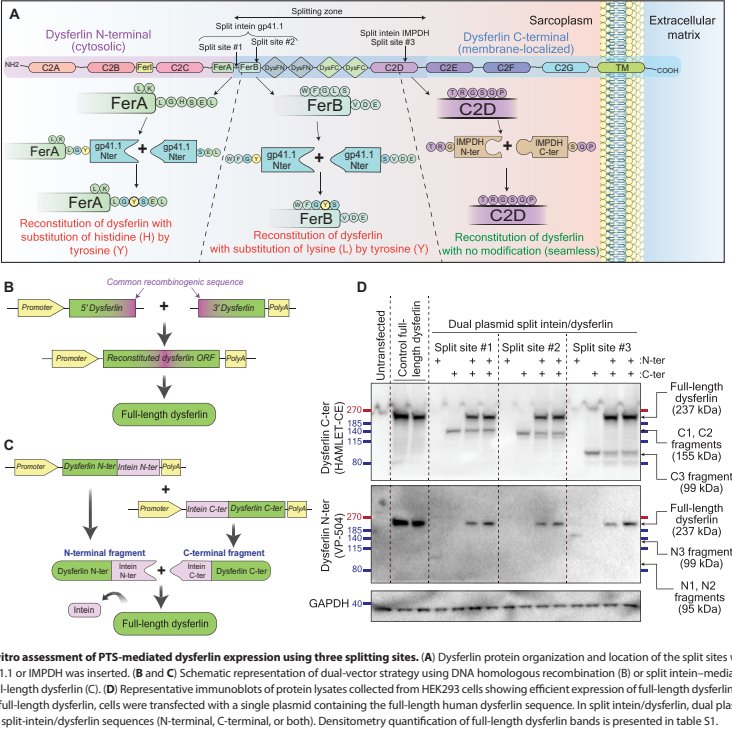
The authors predicted three sites in the dysferlin sequence where split inteins could be inserted. Among these, the IMPDH intein at site 3 (between Gly1263 and Ser1264) achieved "scarless" ligation, with the highest full-length protein expression on immunoblot.
In Vitro Validation: Can the Reconstructed Protein Repair the Sarcolemma
In HEK293 cells, all three intein combinations were able to reconstruct full-length dysferlin, but IMPDH at site 3 yielded the highest expression levels.
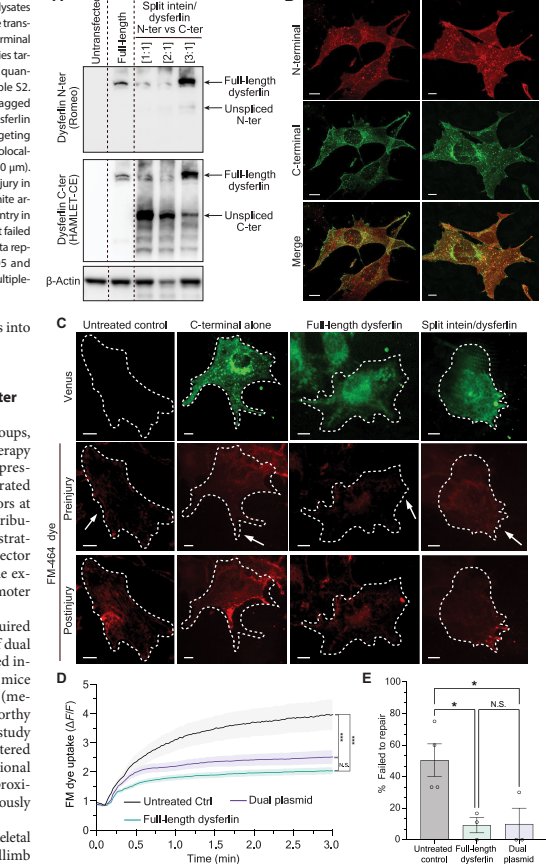
Subsequently, the study tested function in dysferlin-deficient C2C12 myoblasts. When N-terminal and C-terminal plasmids were co-transfected at a 3:1 ratio, full-length protein expression was robust.
Laser injury experiments showed that cells expressing split intein dysferlin had significantly reduced dye entry (P = 0.0075), with the repair failure rate decreasing by more than fourfold.
This indicates that the reconstructed protein does not merely "exist"—it is functionally close to full-length dysferlin expressed from a single vector.
In Vivo Comparison: Where the Efficiency Gap Emerges
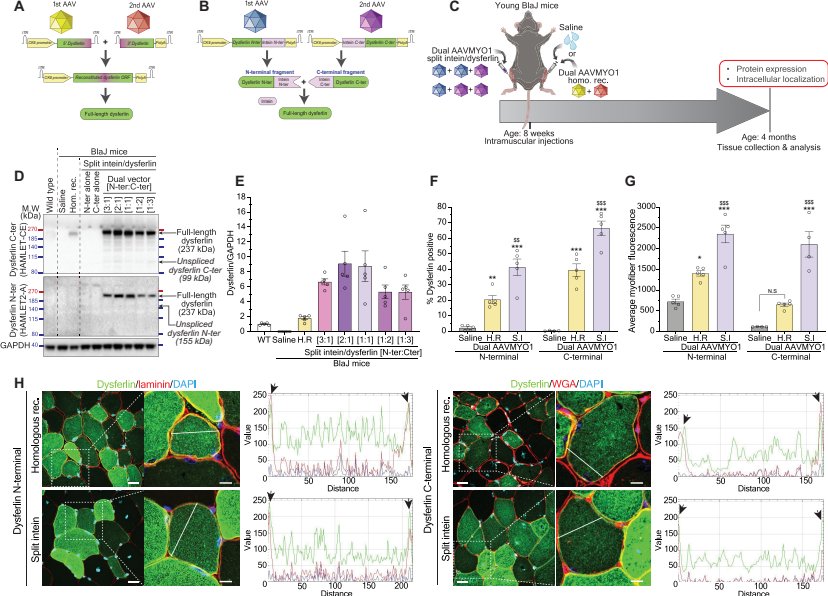
The study packaged SI-Dysf and HR-Dysf separately into muscle-tropic AAVMYO1 vectors, driven by the muscle-specific CK8e promoter.
After injecting the same total dose (6×10¹⁰ vg) into the tibialis anterior of 8-week-old BlaJ mice, tissues were harvested at four months. All SI-Dysf N:C ratios produced higher levels of full-length protein than HR-Dysf, with 2:1 and 1:1 ratios being optimal.
Immunostaining showed that the number of dysferlin-positive muscle fibers in the SI-Dysf group was approximately twice that of the HR-Dysf group, with brighter signal.
More critically: unspliced N-terminal or C-terminal fragments were nearly undetectable in the SI-Dysf group. In contrast, the HR-Dysf group had dysferlin expression levels approximately twice that of wild-type—but this included truncated fragments.
Dose and Distribution of Systemic Delivery
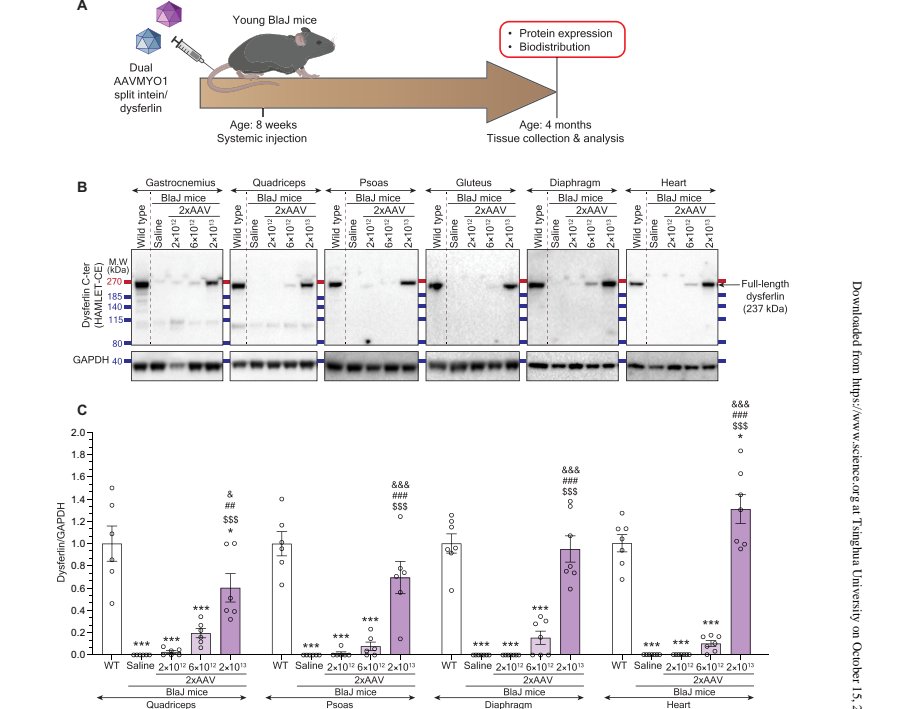
LGMDR2 involves multiple muscle groups, and local injection is insufficient for coverage. The study administered three doses via tail vein injection: 2×10¹², 6×10¹², and 2×10¹³ vg/kg.
Two months later, full-length protein was undetectable in the low-dose group; the mid-dose group reached approximately 10–40% of wild-type; the high-dose group reached approximately 70% in the quadriceps and psoas, with even higher levels in the diaphragm and heart.
Notably, the highest dose is still tenfold lower than preclinical or clinical doses of conventional AAV serotypes used for muscle diseases, and approximately fivefold lower than the previous HR-Dysf regimen.
Early and Late Disease: Differences in Functional Endpoints
In 6-month-old (disease onset stage) BlaJ mice, systemic administration at 2×10¹³ vg/kg was performed, with assessment six months later.
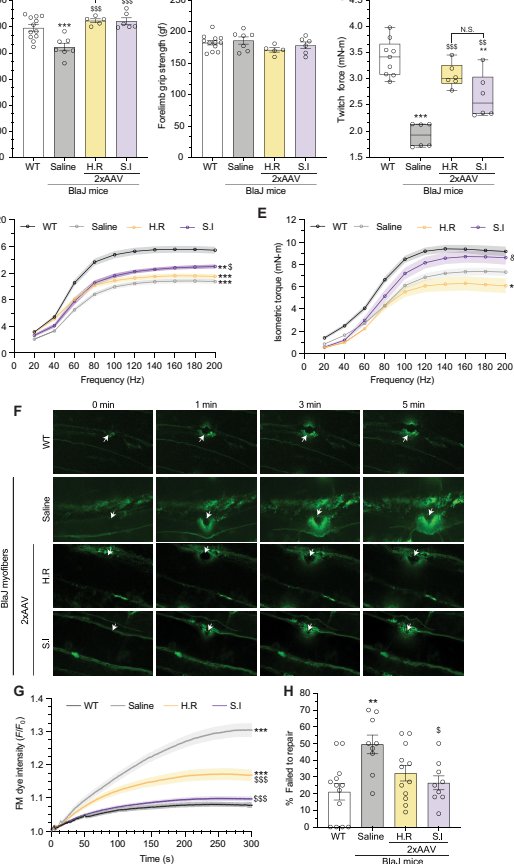
The SI-Dysf group reached 60–70% of wild-type dysferlin levels in the gastrocnemius and quadriceps, while the HR-Dysf group reached only 5–15%. Vector genome quantification showed similar AAV presence in both groups—the difference arose from splicing efficiency, not delivery efficiency.
Histologically, the SI-Dysf group showed reduced centrally nucleated fibers, increased muscle fiber cross-sectional area, and reduced fatty infiltration.
Functionally, whole-limb grip strength deficits were prevented, gastrocnemius twitch force was restored, and force recovery after eccentric contraction was better. Laser injury experiments showed that muscle fiber repair capacity in the SI-Dysf group approached wild-type, with the repair failure rate decreasing by nearly twofold.
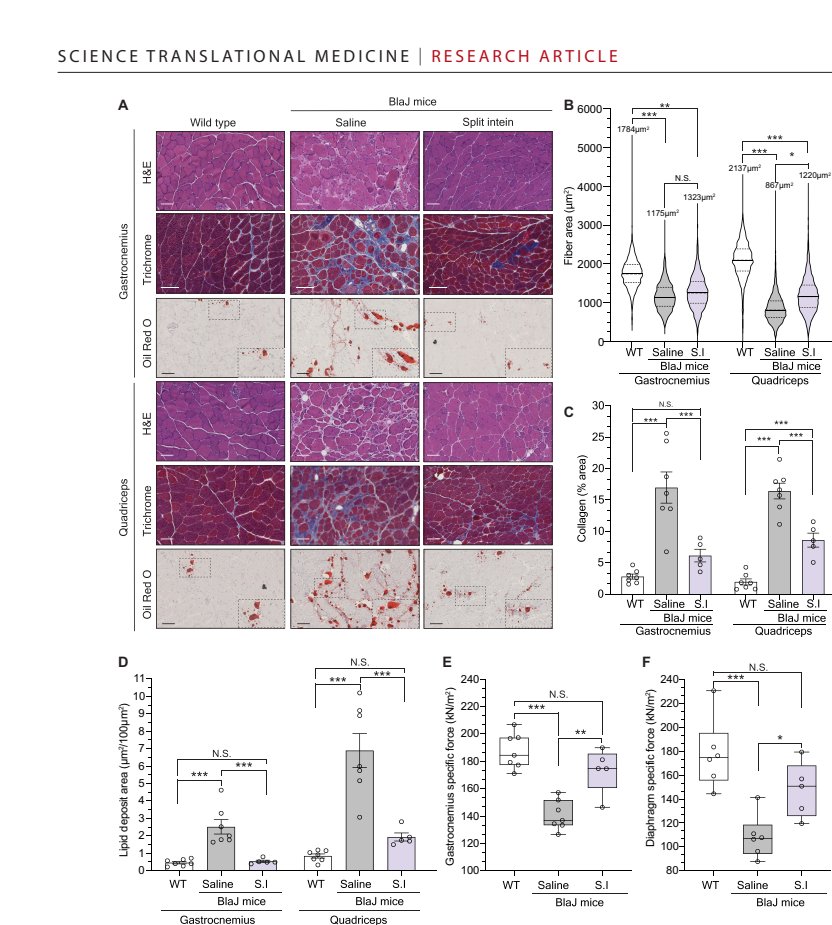
In 12-month-old (late-stage symptomatic) mice, after six months of treatment at the same dose, dysferlin levels in the gastrocnemius and diaphragm reached or even exceeded wild-type, and the quadriceps reached 2–3 times wild-type levels.
Fibrosis area decreased from approximately 18% to 6–9%, lipid deposition was significantly reduced, and specific contractile force of the gastrocnemius and diaphragm improved.
Process Perspective: What This Study Leaves Behind
From the perspective of AAV process development, this work has several observations worth recording.
First, ratio control of the two vectors is a process parameter, not an ancillary detail. The in vivo N:C ratio affects full-length protein yield and residual unspliced fragments. 1:1 and 2:1 performed optimally, but how to ensure batch-to-batch ratio consistency is a question that must be answered for scale-up manufacturing.
Second, splicing efficiency can partially offset dose requirements. At the same vector genome level, the PTS strategy's protein output is significantly higher than that of DNA recombination. This means that in pursuing efficacy, vector design may be more effective than simply increasing dose.
Third, detection of truncated fragments should be incorporated into the quality control scope. The presence of unspliced N-terminal (155 kDa) and C-terminal (99 kDa) fragments on immunoblot suggests that protein-level product-related impurity analysis cannot focus solely on the full-length band.
Fourth, the study itself leaves unresolved questions. The authors note that split inteins are mostly derived from microorganisms, and their expression, half-life, and immunogenicity in human cells remain unclear; the immune responses to the AAV vector, intein components, and reconstructed dysferlin have also not been deeply characterized.
Furthermore, dysferlin expression shows a mosaic distribution, with not all muscle fibers expressing uniformly. How to achieve more uniform distribution through next-generation muscle-tropic capsids, stronger muscle-specific expression cassettes, or protein sequence modifications remains an open question.
When vector capacity becomes a hard constraint, should we continue searching for recombination solutions at the DNA level, or redesign the splicing logic at the protein level? This choice may affect more than just one target—dysferlin.

