



- • Up to 20% off your first purchase
- • Bulk quantities available
- • Citation Reward application
Supports
- Talk to our Expert:
[email protected] -
Talk to our sales:
[email protected]
Protocol Library Download
 |
 |
SOLIDEX®-ISOEx anti-Biotin Nanobeads (Column-based) (Cat No.:GMP-SMT-219-Ab01-nanoIMB)
SOLIDEX ® -ISOEx anti-Biotin Nanobeads (Column-Based) are used to enrich or deplete cells labeled with one or more biotinylated antibodies for Column-Based method
Check GeneMedi's SOLIDEX™-ISOEx Cell Isolation Kit & Nanobeads
 COA
COAOrder information
| Catalog No. | Product Name | Size | Price(In USD) |
|---|---|---|---|
| GMP-SMT-219-Ab01-nanoIMB-0.5mL | SOLIDEX®-ISOEx anti-Biotin Nanobeads (Column-based) | 0.5mL | 302 |
| GMP-SMT-219-Ab01-nanoIMB-1mL | SOLIDEX®-ISOEx anti-Biotin Nanobeads (Column-based) | 1mL | 531.51 |
| GMP-SMT-219-Ab01-nanoIMB-7.5mL | SOLIDEX®-ISOEx anti-Biotin Nanobeads (Column-based) | 7.5mL | 2126.06 |
Description
| Cat No. | GMP-SMT-219-Ab01-nanoIMB |
| Product Name | SOLIDEX®-ISOEx anti-Biotin Nanobeads (Column-based) |
| Description |
SOLIDEX ® -ISOEx anti-Biotin Nanobeads (Column-Based) are used to enrich or deplete cells labeled with one or more biotinylated antibodies for Column-Based method |
| Application |
SOLIDEX ® -ISOEx anti-Biotin Nanobeads (Column-Based) is used to positive selection, negative selection and depletion of human and cells. |
| Format | Column-Based |
| Key feature |
- Exceptional Anti-Interference: Utilizing rigorously screened antibodies (e.g., Clone G), the nanobeads withstand extreme free biotin levels (> 100 ng/mL). This prevents premature blocking and competitive displacement of targets, ensuring sorting accuracy for clinical samples. - Streamlined GMP Processes: Thanks to their superior stability and a "no debeading required" characteristic, these anti-interference nanobeads are ideal for both high-standard research sorting and significantly simplifying GMP manufacturing workflows for clinical cell therapies. - Unaffected by free biotin (suitable for whole blood) - Efficient cell sorting - Minimal impact on downstream applications - Suitable for rare cell isolation, such as CTCs or low-abundance immune cell subsets |
| Storage | Store at 2-8 ℃. Do not freeze. |
Validation Data
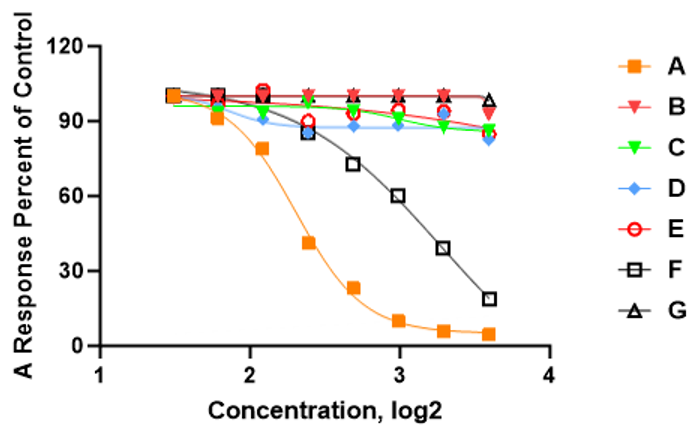
High Interference Resistance of SOLIDEX®-ISOEx Anti-biotin Nanobeads (Column-based) Against Free Biotin.
Catalog No. GMP-SMT-219-Ab01-nanoIMB
Characterization of the elution profile of anti-biotin antibodies using a competitive free biotin assay. The figure demonstrates the signal retention of various antibody clones in the presence of gradient concentrations of free biotin. Under free biotin competition, anti-biotin antibody G maintains the highest signal, demonstrating an extremely tight binding affinity. Anti-biotin antibody G tolerates biotin interference well beyond human physiological limits (>100 ng/mL, simulating plasma levels of patients taking biotin supplements). This indicates that anti-biotin antibody G is highly suitable for developing interference-resistant (non-releasable) anti-biotin nanobeads; conversely, anti-biotin antibody A is highly sensitive to free biotin, displaying a significant leftward shift in its curve. This property enables highly efficient and rapid elution at lower biotin concentrations, making it ideal for releasable nanobeads.
Figure 22. The free biotin competition assay reveals significant performance differences between interference-resistant anti-biotin nanobeads and releasable nanobeads. Anti-biotin antibody G exhibits exceptionally high binding stability, whereas anti-biotin antibody A is highly sensitive to competition, facilitating rapid and gentle elution at low biotin concentrations (A - G represent distinct anti-biotin antibody clones).
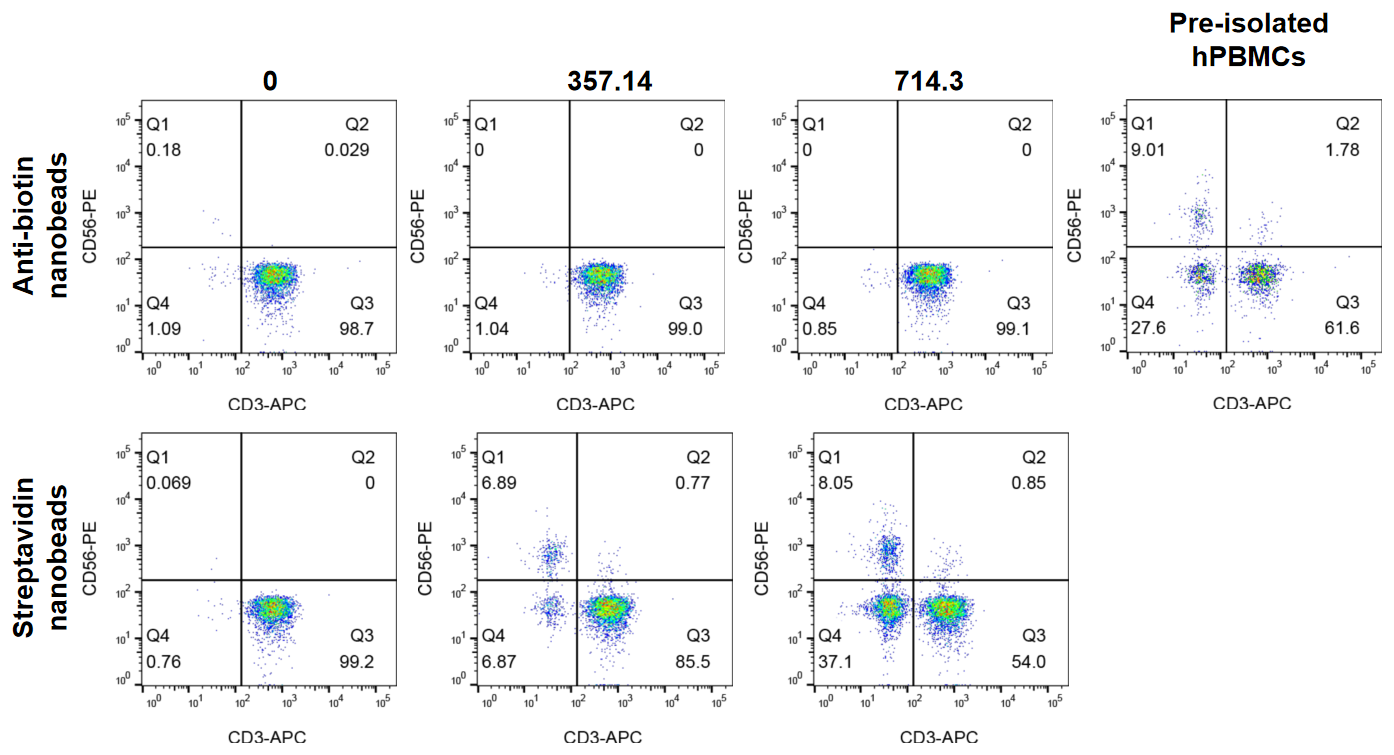
Superior Free Biotin Resistance of Anti-Biotin Nanobeads Over Streptavidin Nanobeads in Cell Isolation
SOLIDEX®-ISOEx Anti-biotin Nanobeads (Column-based)
Catalog No. GMP-SMT-219-Ab01-nanoIMB
Human peripheral blood mononuclear cells (hPBMCs) were labeled with a biotinylated monoclonal antibody and subjected to magnetic cell isolation using either Anti-Biotin Nanobeads (top row) or Streptavidin Nanobeads (bottom row) in the presence of increasing concentrations of free biotin (0, 357.14, and 714.3 ng/mL). Isolated target fractions and pre-isolated hPBMCs (far right) were stained with CD3-APC and CD56-PE, followed by flow cytometric analysis. Anti-Biotin Nanobeads successfully overcome the free biotin susceptibility inherent to traditional Streptavidin-based magnetic beads. They represent a superior, reliable solution for demanding cell separation workflows (such as NK cell or T cell isolation) where free biotin contamination is present.
Figure 21. Flow cytometric comparative analysis of free biotin resistance between Anti-Biotin Nanobeads and Streptavidin Nanobeads in cell isolation. The anti-biotin nanobeads show strong free biotin resistance in NK cell isolation, while streptavidin nanobeads are significantly blocked by free biotin.
Click to get more Data / Case study about the product.