

CD138+ Cells primarily refer to plasma cells, which are effector cells differentiated from B cells. These cells are found in the bone marrow, lymphoid tissues, and peripheral blood, and are responsible for antibody secretion (such as IgG, IgA). Plasma cells play a key role in adaptive immunity.
CD138 (also known as Syndecan-1) is a transmembrane glycoprotein specifically expressed on the surface of plasma cells and some epithelial cells, with particularly high expression in mature plasma cells. It is not found on early B cells or other blood cell types, providing highly specific expression. GeneMedi offers CD138 magnetic beads for the positive selection or depletion of CD138+ cells to meet various research and therapeutic needs.
CD138 (Syndecan-1) is commonly used as a marker for plasma cells and many multiple myeloma cells. In bone marrow samples, target plasma cells coexist with other hematopoietic cell populations, and the proportion of plasma cells can vary considerably between samples.
Enriching CD138+ cells before selected downstream assays can help increase the representation of target plasma cells in the sample. Depending on your research objectives, CD138+ cell isolation may be used as a preparation step for cytogenetic analysis, genomic studies, molecular profiling, or selected cellular assays. Alternatively, CD138+ cell depletion can be used when the remaining cell population is the focus of the study.
SOLIDEX®-ISOEx Human CD138 Isolation Solutions offer positive selection and CD138+ cell depletion options to support different research workflows.
Choose an application below to explore how CD138+ cell isolation or depletion may fit into your experimental workflow.
Enrich CD138+ plasma cells before FISH analysis
In multiple myeloma research, bone marrow samples contain a mixture of plasma cells and other hematopoietic cells. When plasma cells represent a relatively small proportion of the sample, analyzing unselected cells may reduce the representation of myeloma-associated cytogenetic abnormalities.
CD138+ plasma cell enrichment can be used before fluorescence in situ hybridization (FISH) to increase the representation of target plasma cells in the analyzed population. A published study reported that immunomagnetic CD138-positive cell sorting increased the proportion of abnormal cells identified by FISH compared with analysis without plasma cell purification.
Enrich target plasma cells for genomic and molecular studies
In multiple myeloma research, genomic analysis may be affected by the presence of non-target cells in the starting sample. Enriching CD138+ plasma cells before nucleic acid preparation can help focus downstream analysis on the target cell population.
Published research has used CD138-enriched bone marrow plasma cells for genomic and copy-number analyses.
Study gene expression and molecular profiles in plasma cells
Multiple myeloma cells exhibit molecular heterogeneity. Researchers may need to characterize gene expression, protein profiles, or differences between plasma cell populations.
CD138-based magnetic enrichment has been used in published studies involving single-cell RNA sequencing and proteomic analysis of plasma cell populations.
Enrich patient-derived myeloma cells for drug response research
Researchers may use patient-derived multiple myeloma cells to investigate responses to individual compounds or drug combinations. Published research has incorporated CD138+ plasma cell enrichment into workflows for ex vivo drug sensitivity testing of patient-derived myeloma cells.
Remove CD138+ plasma cells to study the remaining bone marrow cell population
Not every study aims to collect CD138+ plasma cells. In some experiments, the research objective is to investigate the remaining bone marrow cell population after plasma cell depletion.
Published studies have analyzed bone marrow cell populations after CD138+ cell depletion to investigate the cellular composition and immune microenvironment associated with multiple myeloma.
CD138 magnetic beads are used to isolate pure plasma cells, enhancing the sensitivity and reliability of techniques such as FISH (Fluorescence in situ hybridization), microarray genomic analysis, and genome sequencing. This is particularly useful in multiple myeloma research. The efficient pre-enrichment of plasma cells supports cytogenetic analysis of bone marrow samples, revealing chromosomal abnormalities or gene mutations.
Positive selection of CD138+ plasma cells is used to study cell surface antigen expression in multiple myeloma, where the complete loss or insufficient expression of CD138 is associated with disease progression. This provides valuable insights for the optimization of diagnostic and therapeutic strategies.
| Cat.No | Product Name | Products Information |
|---|---|---|
| GM-Tg-hg-T13017-iso-nanoIMB | SOLIDEX®-ISOEx Human CD138 Isolation Nanobeads (Column-based) | Details |
| GM-Tg-hg-T13017-iso-nanoIMB-CF | SOLIDEX®-ISOEx Human CD138 Isolation Nanobeads (Column-free) | Details |
| GM-Tg-hg-T13017-iso-rel-kit | SOLIDEX®-ISOEx Indirect Releasable Human CD138+ Cell Isolation Kit (Column-based) | Details |
| GM-Tg-hg-T13017-iso-rel-kit-CF | SOLIDEX®-ISOEx Indirect Releasable Human CD138+ Cell Isolation Kit (Column-free) | Details |
| GM-Tg-hg-T13017-iso-kit | SOLIDEX®-ISOEx Indirect Human CD138+ Cell Isolation Kit (Column-based) | Details |
| GM-Tg-hg-T13017-iso-kit-CF | SOLIDEX®-ISOEx Indirect Human CD138+ Cell Isolation Kit (Column-free) | Details |
Removal of CD138+ cells from PBMCs or bone marrow to obtain pure T cells or early B cells, for use in B cell differentiation studies or the development of immunotherapies.
| Cat.No | Product Name | Products Information |
|---|---|---|
| GM-Tg-hg-T13017-dep-nanoIMB | SOLIDEX®-ISOEx Human CD138+ Cell Depletion Nanobeads (Column-based) | Details |
| GM-Tg-hg-T13017-dep-kit | SOLIDEX®-ISOEx Indirect Human CD138+ Cell Depletion Kit (Column-based) | Details |
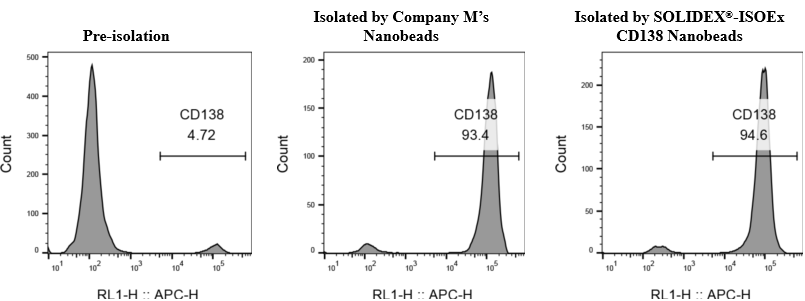
Figure. Efficient isolation of CD138+ cells from a mixture of human PBMCs and U266 cells using SOLIDEX®-ISOEx Human CD138 Isolation Nanobeads (Column-Based). Cells were stained with APC-conjugated anti-CD138 antibody and analyzed by flow cytometry; histograms show the RL1-H::APC-H channel and the values indicate the percentage of CD138+ cells within the gate. CD138+ cells were 4.72% before isolation, 93.4% after isolation with Company M nanobeads and 94.6% after isolation with SOLIDEX®-ISOEx CD138 Nanobeads.
Are you optimizing a plasma cell isolation workflow or evaluating a CD138+ enrichment method for your downstream research?
Share your sample type, approximate starting cell number, downstream application, and existing magnetic separation equipment with us. Our team can help you assess the appropriate SOLIDEX®-ISOEx CD138 product format for your experimental needs.
Request a Sample | Request Validation Data | Discuss Your Workflow | Request a Quote
SOLIDEX®-ISOEx Human CD138 Isolation Solutions are designed to enrich CD138-expressing cells or deplete CD138+ cells from human samples. They are particularly suitable for plasma cell enrichment in multiple myeloma research and can be evaluated for downstream applications such as FISH, NGS, genomic analysis, and selected cellular studies.
The appropriate product should be selected according to the sample type, downstream application, and required isolation format.
Human bone marrow is an important sample type for CD138+ plasma cell enrichment, particularly in multiple myeloma research. Depending on the intended application and product specifications, PBMCs and lymphoid tissues may also be considered.
Sample quality, target cell abundance, and sample preparation conditions can affect isolation performance. Please refer to the Instructions for Use (IFU) of the selected product to confirm its suitability for your sample type.
CD138+ Positive Selection is designed to enrich and collect the CD138-expressing target cell population for downstream analysis.
CD138+ Cell Depletion is designed to remove CD138-expressing cells so that the remaining cell population can be collected for further research.
Choose positive selection when your primary objective is to obtain CD138+ plasma cells. Choose cell depletion when your research focuses on the remaining cell population, such as non-plasma-cell components of bone marrow.
Please note that CD138+ cell depletion does not directly purify a specific non-CD138+ cell type.
Column-based products use a magnetic separation column as part of the isolation workflow.
Column-free products are designed for workflows that do not require a separation column. However, a suitable magnetic separation device may still be required, depending on the product instructions.
The choice depends on your existing equipment, preferred workflow, sample input, and the operating requirements of the selected product. Column-free does not necessarily mean equipment-free.
Direct CD138 isolation nanobeads recognize and bind target cells through a CD138-specific binding component associated with the magnetic beads.
Indirect CD138 isolation kits first use a biotinylated anti-CD138 antibody to label the target cells, followed by anti-biotin magnetic nanobeads for magnetic separation.
The two formats differ mainly in their cell-labeling strategies and product components. Please refer to the specifications and IFU of each product to determine which format best fits your experimental workflow.
The choice depends on whether magnetic bead removal is required for your downstream application.
Releasable products are designed to allow magnetic bead removal using the supplied dissociation buffer and the prescribed procedure. They may be considered for applications in which bead removal is desired before subsequent analysis or cell-based experiments.
Non-releasable products are designed for workflows in which magnetic bead release is not required.
For applications involving cell culture, functional assays, or cell-surface marker analysis, consider whether bead removal is necessary and evaluate the potential effects of the isolation procedure on your downstream results.
Yes. SOLIDEX®-ISOEx CD138 magnetic bead products are compatible with commonly used magnetic separation systems and related separation consumables available on the market, including products from Miltenyi.
If you currently use a Miltenyi OctoMACS separator with MS Columns, you can continue using your existing equipment and compatible separation columns with the appropriate SOLIDEX®-ISOEx CD138 products. There is no need to purchase additional magnetic separation equipment solely to use GeneMedi magnetic beads.
For product-specific operating instructions and conditions, please refer to the corresponding IFU. You are also welcome to contact our technical support team for further assistance.
CD138+ cell enrichment can be used as a sample preparation step for selected downstream applications, including FISH and genomic studies. However, the suitability of isolated cells depends on the requirements of the specific analytical method.
For FISH or NGS workflows, consider target cell purity, recovered cell number, sample quality, and downstream sample preparation requirements.
For cell culture or functional assays, additional considerations may include cell viability, magnetic bead removal requirements, and potential effects of the isolation procedure on cell phenotype or function.
We recommend validating the suitability of isolated cells under your intended experimental conditions.




